Buescher 400 alto saxophone
 Origin:
USA Origin:
USA
Guide price: Anything less than £800 is a bargain
Weight: -
Date of manufacture: Late 1950s
Date reviewed: August 2002
A top level vintage horn, sporting a host of unusual
design features that make it one of the most interesting instruments out
there
There are plenty of good reasons for buying a vintage horn - and quite
a few bad ones too, of which how it looks is perhaps the biggest no-no
of all. It's not a problem if all you're going to do is nail it to a wall
and stare at it, but if you intend to play it with any conviction there
will be far more important considerations that should take precedence...such
as build quality, ergonomics, tuning, tone etc.
Wouldn't it be nice if you could have both? All the boring 'essential'
stuff such as build quality, good tuning...blah blah - coupled with a
design that just screams elegance. Step forward, the Buescher 400.
Now this is a beautiful horn.
Seriously, I don't mean it merely looks nice, or even unusual, it's very
definitely a beautiful horn.
The first thing that hits the eye is the profile of the bell. It looks
shorter than a typical bell, but this is an optical illusion brought about
by a combination of a flare that starts lower down than on your average
horn and ends in a wider bell rim (by about a centimetre or so) - with
the added difference of the bell key cups being situated to the rear of
the bell. Also, the bell is set slightly further out from the body than
on a modern horn, which lends the instrument a very open and uncluttered
look.
There's just something about the visual balance of this horn that sets
it apart from all the others; the Martins, the Conns, the Kings - and
even the more esoteric brands like Couesnon and Pierret.
But does such beauty come at a price? Let's find out.
The build quality is good, as you'd expect from a top-flight vintage
horn. A nice touch is the nickel silver band that runs around the underside
of the bell. This helps to strengthen the bell flare - but you'd better
not drop this horn on its bell, repairs would be difficult and expensive.
The crook is fitted with a pseudo-underslung key - that's to say that
although most of the key runs beneath the crook, the octave key nipple
sits atop the crook as per a standard horn. Looks familiar? Yep, it's
the same sort of design that you'll find on modern Yanagisawa horns (and
their Chinese lookalikes). As is so often the case with 'modern design
features' on saxes, someone else thought of them almost a century ago.
The body is constructed with individual pillars, with each pillar featuring
a diamond-shaped base. This gives the pillars a secure footing as well
as looking quite distinctive.
As you might expect with a horn of this vintage there are few mod-cons.
There's no detachable bell - which some players would regard as an advantage,
and no adjustable thumb hook - which few players would regard as an advantage.
The bell key guards are quite basic, being of the round wire type
and with no provision for key height adjustment (though you can
simply tweak the buffer felts) - and there are only two of them
anyway as the low B/Bb keys don't require them.
 A
major weakness of vintage body designs is often the bell brace, and the
Buescher is no different from many other such horns in this respect. A
major weakness of vintage body designs is often the bell brace, and the
Buescher is no different from many other such horns in this respect.
It's a very simply yet elegant design but in practical terms it's about
as much use having a spike fitted to the centre of your steering wheel.
The brace itself is fitted square-on to the main body tube, and the mount
on the body is just a small plate - little bigger than those fitted to
the pillars. When the horn takes a serious knock to the front of the bell
(as would happen if you dropped the horn), a large part of the impact
force will be directed through this small plate - with the result that,
at best, the brace would leave a substantial dent in the body (right between
two tone holes too) and at worst the body would fold up around the brace
mount point.
I realise it all sounds a bit doom-and-gloom, but it's as well to be aware
of this Achilles heel - both in terms of day-to-day handling of the horn
and when it comes to examining one prior to purchase. Always, always check
out this spot for evidence of damage. Don't be too concerned to see that
the brace has been resoldered though - this may just mean it popped off
(another common problem with vintage bell braces) - but do check the surrounding
area for signs of repairs...and take a peek down the bore too, you might
be able to see ripples in the bore beneath the bell stay body mount.
The funny thing is, the band fitted under the bell rim will add stiffness
to the bell - but this will mean more of the impact force will be transmitted
to the bell brace. This is why cars are designed with 'crumple zones'...the
less important bits absorb the impact, the important bits (the people
in the car...or this case the horn's body) survive reasonably intact.
 The
crook clamp is an interesting design. It's obviously a great deal beefier
than the usual affair, but it also doubles up as a lyre clamp. The
crook clamp is an interesting design. It's obviously a great deal beefier
than the usual affair, but it also doubles up as a lyre clamp.
I'm not too sure how well this would work in practice as it's entirely
possible that the shaft of the lyre could prevent the clamp from fully
tightening around the tenon sleeve - so you might either have to put up
with a loose lyre or a loose crook. I'm sure there would be ways around
it - one of the best being not to go marching with such a fine horn.
There is another drawback to the chunkiness of the clamp, and that's the
temptation to overtighten it. For sure, there's no doubt it's up to the
job - a bit of looseness in the socket would just disappear with an extra
turn of the screw - but that's not how a crook clamp is supposed to work.
Your crook joint should be a snug, airtight fit before you even touch
the clamp screw - it's only meant to just nip the joint up to prevent
the crook from swivelling. Using the clamp to act as a seal will eventually
stretch it, and that often leads to cracks developing in the socket -
so if your crook is at all loose, have your repairer expand the tenon
sleeve. It's not an expensive job.
One last little feature that's worth a mention is the Buescher logo on
the bell. It's a fitment, picked out in silver or nickel plate (see below).
I love this feature, though regrettably it disappeared from later models.
I'd love to see it make a comeback, rather like the pseudo underslung
octave key.
 The
keywork is very well built - a bit old-fashioned in some places (but not
all, as we'll see shortly) but beautifully made and finished in nickel
plate on this example. There are a number of small features that just
give the impression that someone has put a lot of thought into the design
- and not just for its own sake - there's functionality there as well
as elegance. The
keywork is very well built - a bit old-fashioned in some places (but not
all, as we'll see shortly) but beautifully made and finished in nickel
plate on this example. There are a number of small features that just
give the impression that someone has put a lot of thought into the design
- and not just for its own sake - there's functionality there as well
as elegance.
The bars for the Aux. B and F are my favourite feature. This bar is usually
either a round rod or a flat one (sometimes even a half-round rod), and
as such it's prone to flexing. It's not by much, but it's enough to make
a difference. It's most noticeable on the low D - and even with the most
carefully set pad and the tightest action, there will still be a bit of
flex in the auxiliary bar to contend with - and this is done by slightly
backing off the regulation on the low D key.
Not a problem with this bar. As you can see, it's still a flat rod but
it's been fitted so that the 'working edge' is the narrow side of the
bar (the norm is that the widest face of the bar would be sat over the
key feet). This gives the bar a great deal more stiffness and makes regulation
a breeze. It's such a simple and effective solution that I really don't
know why it isn't standard on modern horns. Mind you, it would be even
better if there were a set of adjusting screws built into the bar...but
you can't have everything.
While I'm on the subject of adjusters, there aren't any built into
the Bis Bb/G# bar either.
 Another
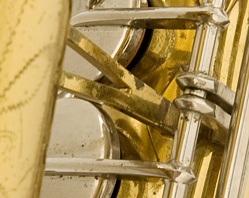
nice touch is the bridge mechanism for the low C# key. Another
nice touch is the bridge mechanism for the low C# key.
The low C# key cup itself pivots on the right hand stack rod (at the rear
in the photo) - the key barrel sits just below the low D key barrel -
and there's a short link (the bridge) that connects to the low C# lever
key barrel (at the front in the photo). Again, someone thought long and
hard about this, it lends a very light and positive feel to the action
- as long as there's not too much wear in the bridge key barrels, which
pivot on a pair of tiny rod screws.
Even the compound pillar that holds all the key barrels in place is a
nice design.
 The
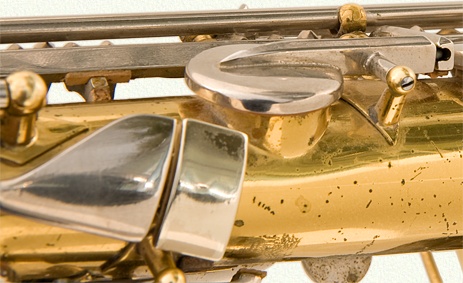
side Bb/C linkage is rather unusual. The link itself is a metal pin bent
at 90 degrees, one end of which slots into the key cup arm, the other
into the actuating arm. The
side Bb/C linkage is rather unusual. The link itself is a metal pin bent
at 90 degrees, one end of which slots into the key cup arm, the other
into the actuating arm.
At first glance it seems like a bit of a kludge but in practice it works
quite well, and is less noisy than you'd imagine - but you wouldn't ever
want to lose the pin as it's a bit more complex that just a bent bit of
rod.
This bent pin link is used again on the octave key mechanism, to connect
the body octave key pad to the thumb key mechanism.
Note the rather unique design of the octave key touchpiece
and thumb rest.
Look great, but in practice I found the rest to lack sufficient support
for the rear of the thumb - it could do with being a bit wider. The octave
key touchpiece, though, is very comfortable in use - so I guess this is
one area where the designer got a little bit carried away.
Not to worry though, you can always mod it with a packet of Sugru.
 I
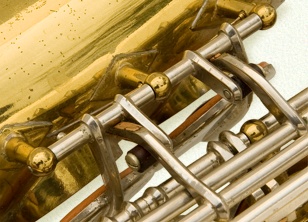
mentioned earlier that the design of the low B and Bb keys means they
don't have the usual bumper felts fitted - and that's because there's
nowhere to fit them. There's no key guard. I
mentioned earlier that the design of the low B and Bb keys means they
don't have the usual bumper felts fitted - and that's because there's
nowhere to fit them. There's no key guard.
Instead, the lever arms act as both the actuators for the key cups and
as the buffers. It's a clever design, one perhaps that was gleaned from
watching wrestlers perform leg locks. It's also quite a good mechanism
for preventing key bounce, because as the key cups rise the lever arm
contacts the key cup barrel and acts as a sort of brake. Probably a feature
that's more by accident than design (but who knows?), but it works...and
that's what matters.
On the whole, the action is a curious blend of the old and
the new. It was designed at a time when manufacturers were moving away
from the principle of 'bung everything on a single pivot', and thus the
top stack is separated out into three parts; the main stack, the Bis Bb
and the G key - all on their own pivots.
Likewise, the two-part side keys are up-to-date, as is the inclusion of
the front top F key and the generously-proportioned bell key table. And
yet there's the lack of adjusters on the Bis Bb/G# bar and the old teardropped
side F# key and the basic spatulas on the low C/Eb keys. The Buescher
gets away with it though, because it all works - and in some ways it puts
me in mind of one of those sci-fi films in which the future is portrayed
in a very 'retro' style, and where the baddie brandishes a phaser whilst
sporting a very fine waxed moustache and a top hat.
 And
speaking of villains - the Buescher 400 is fitted with the dreaded Norton
springs throughout. Why dreaded? Well, several reasons. Norton springs
are ordinary needle springs that have been pre-fitted into a threaded
brass sleeve. Instead of the usual deal where you simply fit the springs
straight into the pillar, Norton springs have to be screwed in, sleeve
and all. In theory it's great - it means that anyone can change a spring.
In practice the idea fails because you'd still have to be able to dismantle
(and reassemble) the horn to change most of the springs. Also, it relies
on the availability of replacements, which aren't that common - and if
your repairer doesn't have any Norton springs in stock then you're stuck.
There is a way around this problem, it's fiddly and time consuming
though. And
speaking of villains - the Buescher 400 is fitted with the dreaded Norton
springs throughout. Why dreaded? Well, several reasons. Norton springs
are ordinary needle springs that have been pre-fitted into a threaded
brass sleeve. Instead of the usual deal where you simply fit the springs
straight into the pillar, Norton springs have to be screwed in, sleeve
and all. In theory it's great - it means that anyone can change a spring.
In practice the idea fails because you'd still have to be able to dismantle
(and reassemble) the horn to change most of the springs. Also, it relies
on the availability of replacements, which aren't that common - and if
your repairer doesn't have any Norton springs in stock then you're stuck.
There is a way around this problem, it's fiddly and time consuming
though.
There's also the possibility of the sleeves working loose in the pillars,
which can lead to an unresponsive feel to the action.
Lastly there's the point screws. Regular visitors to my site will be
well aware of my dislike for parallel point
screws - which is what the 400 is fitted with. The use of this type
of screw makes it very difficult to adjust the point screw action for
wear, so it's essential to keep the action well lubricated.
The keywork has a typically vintage feel to it, but whilst it's not perhaps
as slick as a modern horn it's still nonetheless fast and comfortable.
The bell keys fit nicely under the fingers, despite their slightly unusual
angle. The only handling issues I could fault were the top F key touchpiece
tends to obstruct the 2nd and 3rd (A & G) fingers, the unusual rectangular
octave key thumb rest lacks a bit of support for the rear of the thumb,
the right hand thumb rest was a tad small... and the bell key action took
a bit of getting used to due to the slightly different weight distribution
of the cups.
None of these are serious issues and are the sort of thing you'd get used
to in no time at all. You could sort the palm key issue out with a spot
of judicious bending (or realigning, if you want to pay more for the job)
of the F key.
 As
for the playability, well, I found it very hard to decide exactly how
to describe the sound. As
for the playability, well, I found it very hard to decide exactly how
to describe the sound.
On the one hand there's that lovely 'roundness' you'd associate with a
vintage horn, yet at the same time there a crisp brightness that not only
cuts through in the upper register but makes its presence known right
down to the low Bb.
There was something very clearly different about the way I was hearing
the sound. My initial explanation was that the angle and profile of the
bell was the reason - but if you stand the horn up next to a modern one
you'll see that there's very little difference, save for the bell rim
as mentioned earlier.
Perhaps then it's that extra centimetre of flare that throws just that
little extra bit of sound back to the player's ears?
After having blown a mere half dozen notes I convinced myself it was
a ballad horn - with its lyrical sweetness of tone and the way the notes
seems to ooze from the horn.... but a mere few seconds later it turned
into a bop horn, with precise definition of notes in fast passages, coupled
with a edgy dryness to the tone. Or was it a classical horn...with its
even response and hauntingly ethereal presentation? Or a solid rock horn,
with a full-bodied sound that easily filled a room and etched the notes
into the glass on the windows?? Tonewise it could be all things to all
players.
Even as I was sitting here trying to think of how to describe the sound
of this horn, the client (Pete Thomas,
no less) arrived to collect it. He told me his wife described the instrument
as 'the sexiest sax' she'd ever heard.
I don't think I can top that.
|