Robert Martin Macon Constellation tenor (Dolnet M70)
 Origin:
France Origin:
France
Guide price: £800 - £1200
Weight: -
Date of manufacture: 1970s
Date reviewed: November 2009
An unusual and relatively rare horn from one of
the smaller French manufacturers
This very unusual tenor is a stencilled Dolnet - made by Dolnet
but rebadged by another company. The Dolnet (pronounced doll-nay)
company started making saxophones in the late 19th century and continued
right up until the mid 1980's. Over the years they've produced some
fine and distinctive horns, much sought after by those in the know
- though unlike similar companies like Couesnon and Pierret, Dolnets
tend not to be quite so refined in terms of build quality.
Such horns can be quite a bargain for the player who does a spot
of research. The majority of players are well aware of the biggest
names in saxophones, but horns from smaller and less well-known
companies can often prove to be as good as or better than many mainstream
horns, and considerably cheaper to buy.
It gets a bit more complicated if there's a "collector's" interest
though, perhaps due to a design feature or some association with a famous
player - or even just rarity, and that'll mean a premium will be added
to the price - as with this Dolnet stencil. Is it worth it though?
 By
far the most noticeable feature of this horn is the angle of the bell.
With the average tenor held so that the top stack tone holes point directly
forward the angle of the bell is typically around 40 degrees to the left
- the Dolnet's bell sits at around 65 degrees. Quite why the bell was
placed at this angle has been the subject of some debate, but I suspect
it has something to do with marching bands (I considered a bell angled
for playing when seated, but it doesn't work with this horn). By
far the most noticeable feature of this horn is the angle of the bell.
With the average tenor held so that the top stack tone holes point directly
forward the angle of the bell is typically around 40 degrees to the left
- the Dolnet's bell sits at around 65 degrees. Quite why the bell was
placed at this angle has been the subject of some debate, but I suspect
it has something to do with marching bands (I considered a bell angled
for playing when seated, but it doesn't work with this horn).
The bell of a standard tenor sticks out quite some distance when the
horn is held straight out in front, and a knock to the bell could result
in a painful injury to the player's mouth. Angling the bell to the left
makes it less susceptible to knocks...and it might also explain why the
Dolnet is fitted with the heftiest lyre screw I've ever seen.
Another reason to suppose this was the horn's intended use is the build
quality. It's really not that good - mediocre, in fact.
The body itself isn't too bad, but the fittings point to a degree of cheapness.
The simple bell brace isn't particularly sturdy and the thumbhook isn't
much more than a thin plate of brass bent at 90 degrees.
The bell key guards look to have been designed with strength in mind,
they're made from slightly heavier gauge brass than normal and each foot
has a 'step' in it - presumably as a means of absorbing the shock from
a knock. They're functional, if perhaps a little industrial in design.
I wasn't pleased to see that the low B and Bb guards each have one
of the mounting screws facing into the tone hole. This means that
in order to remove the guard you have to get your screwdriver in
under the key pad - or remove the key beforehand (as opposed to
the other screws which can be removed from the 'outside'). It's
not a complaint as such, just a grumble - it makes it a right royal
pain to get the guards off and on in a hurry.
The bottom bow joint is soldered, and fitted with a rather nicely patterned
joint ring - similarly the lower bell ring on the opposite end of the
bottom bow is attractively patterned. These rings, and the engraving on
the bell, are this horn's only concession to elegance.
 The
pillars are very poorly fitted in places, with clearly visible gaps under
the bases where the soldering has been less than careful. The pillars
themselves aren't that well finished either, with machining marks and
crude bases. This seems to jar with the fitment of heavy bell key guards
(as does the simple bell brace), as there's little point in ensuring the
bell keys won't get damaged in the event of a knock while leaving the
rest of the horn somewhat vulnerable. The
pillars are very poorly fitted in places, with clearly visible gaps under
the bases where the soldering has been less than careful. The pillars
themselves aren't that well finished either, with machining marks and
crude bases. This seems to jar with the fitment of heavy bell key guards
(as does the simple bell brace), as there's little point in ensuring the
bell keys won't get damaged in the event of a knock while leaving the
rest of the horn somewhat vulnerable.
This theme continues with the keywork, which turned out to be rather soft
and easy to bend - though to be fair it's neatly built. The design of
the action is also rather crude, particularly the very basic octave key
mechanism and the slightly clumsy bell key spatulas - and a closer inspection
reveals indifferent fitting of the rod screws, with rather more free play
than can be attributed to wear and tear. I think 'functional' is about
as complimentary as it gets, and unless such an action is kept in tip-top
condition it's likely to become quite noisy in a very short space of time.
 All
these factors add up to an action that's more likely to be found on a
student-quality horn rather than a professional one - and what really
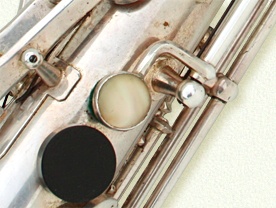
seals the deal is the cavernous gap between the top B and Bis Bb key pearls. All
these factors add up to an action that's more likely to be found on a
student-quality horn rather than a professional one - and what really
seals the deal is the cavernous gap between the top B and Bis Bb key pearls.
While servicing the horn I came across a number of action issues, particularly
the collision of the right hand stack keys with the bell key barrels.
This limited the height of the right hand stack action and required the
careful attention of a file on the cup arms in order to allow the stack
keys to reach their optimum height.
The lack of finesse would seem to support the idea that this is a horn
designed for marching band use. It has specific design features that would
make sense in this situation, and is built to a standard that would be
adequate for a horn that's probably going to get rained on. It might also
explain the large Bis Bb gap...it wouldn't be a problem if you were wearing
gloves...
 One
very interesting feature is the addition of a top F# key. It's very clearly
an addition as the tone hole has been brazed (non too neatly) onto the
body - the rest of the tone holes are drawn. It's also made from noticeably
thicker tube too. One
very interesting feature is the addition of a top F# key. It's very clearly
an addition as the tone hole has been brazed (non too neatly) onto the
body - the rest of the tone holes are drawn. It's also made from noticeably
thicker tube too.
Having said that it's just possible that the manufacturers considered
it too problematical to draw out a tone hole so close to the end
of the body tube, and may have decided to resort to soldering it
on instead - although the add-on theory is supported by earlier
versions of the horn without a top F#.
Under the fingers the action feels slightly clumsy, though in fairness
this may have been due to the rather weak springs and the poorly fitted
rod screws - however, even with a tweak I suspect it wouldn't improve
that much. The Bis Bb gap, the simple bell spatulas and the old-fashioned
round button touchpiece on the octave key all conspire to make the action
less than swift.
 Tonewise
the Dolnet has what I would call a very gentle sound. Its tendency
is to the warm, but without being stuffy or muted, and with enough
brightness to add a bit of sparkle to the tone - and although it's
perfectly possible to push this horn, it seems to always drift back
to its natural, easy-going, relaxed tone. It's also quite an introverted
horn, the sound doesn't seem to want to project too far away. Some
horns seem to throw the sound right out in every direction, others
seem more focussed - but the Dolnet like to wrap its tone around
the player. Such a horn would benefit from close-miking techniques
while being blown only moderately hard, though it might take a while
to get the hang of keeping the bell positioned under the mic. Tonewise
the Dolnet has what I would call a very gentle sound. Its tendency
is to the warm, but without being stuffy or muted, and with enough
brightness to add a bit of sparkle to the tone - and although it's
perfectly possible to push this horn, it seems to always drift back
to its natural, easy-going, relaxed tone. It's also quite an introverted
horn, the sound doesn't seem to want to project too far away. Some
horns seem to throw the sound right out in every direction, others
seem more focussed - but the Dolnet like to wrap its tone around
the player. Such a horn would benefit from close-miking techniques
while being blown only moderately hard, though it might take a while
to get the hang of keeping the bell positioned under the mic.
It gets quite interesting when you apply a bit of rock 'n roll growl
though - the warmth and relaxed approach adds up to a distinctly creamy
tone...very thick and filling, but with a nice 'lazy' feel about it.
This all sounds very positive, but in some ways it can be quite
limiting and can leave you feeling the horn is a bit of a one-trick-pony.
If you wanted to use the horn in anything other than a small combo
or solo miked, I think it would struggle to cut through both in
terms of tone and volume.
Another curious aspect is the effect of having the bell at such
an offset. Granted, not much of a saxophone's sound comes out of
the bell but there's enough to make it noticeable when the bell
is oddly positioned (which is why the Keilwerth
straight alto sounds odd, and players swear that curved sopranos
sound different to straight ones). As such, the Dolnet's sound seems
to be accentuated in your left ear - which leaves you feeling a
little unbalanced. The unexpected result of this is a tendency for
the player to keep turning to the left, almost in an effort to chase
the sound with the right ear. Given the horn's probable intended
use as a marching band horn, it's probably not a good idea to put
a row of these saxes at the front - the band would wander around
in a circle...
It becomes very evident to the listener when the player hits a low
B or Bb - it's almost like they've taken a step sideways. Very disconcerting.
The tuning was good. Some Dolnet's have a reputation for poor tuning,
and it occurs to me that if anyone finds problems with this horn then
it might well be due to the design flaw that limits the height of the
right hand stack. With this stack set low I wouldn't be surprised if there
were some issues at the top end. I think too that this modification would
resolve any unevenness in the tone, should you find any.
The Dolnet is undoubtedly a very curious horn - the offset bell and the
quirky action stand out, and the subtlety of the tone is quite unique,
and as such it presents a difficult choice for buyers. In terms of build
quality alone I'd find it hard to recommend this horn, and the introspective
tone rules it out as an all-rounder. Dolnet have made some extremely nice
horns, but this isn't one of their best efforts...and while there's no
denying it's a unique instrument, and as such can command quite a high
price, I'm not too sure it's ultimately worth the expense.
|