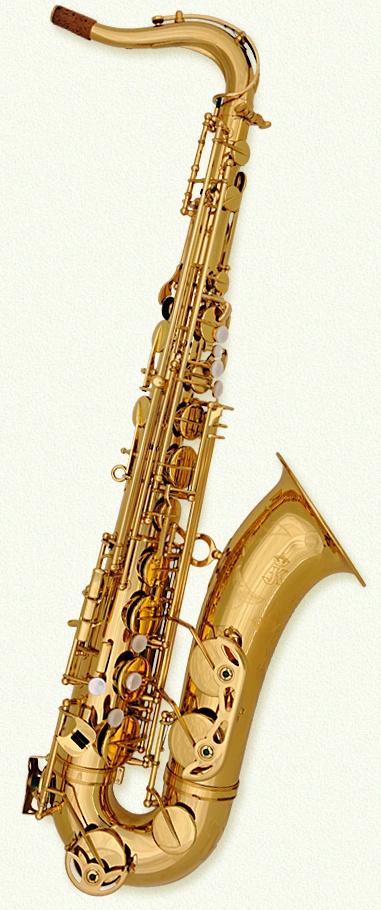
Keilwerth SX90R tenor saxophone (multiple variants)
 Origin:
West Germany Origin:
West Germany
Guide price: £4000+
Weight: 3.52kg
Age of review model: Various
Date reviewed: February 2002 (with
multiple addendums below)
A potentially superb professional level
instrument...with a large caveat...
I have to say that this review may worry quite a few
SX90R owners - so I would welcome comments from other repairers/owners
to incorporate into this review.
Ah, the Keilwerth SX90R. This horn is surely one of
the most famous (or perhaps infamous) horns out there - and quite
possibly due to what follows. But let's kick off with the general
stuff...
Although Keilwerth have been around for a very long
time (in saxophone manufacturing terms), it was only with the advent
of the SX90 series that the 'Big Three' (Selmer, Yamaha and Yanagisawa)
became the 'Big Four'. This in itself is a remarkable achievement.
For sure, if you didn't much like what the Big Three had to offer
there were always a few niche makers to fill the gap (Borgani, Rampone
etc.), but despite their formidable offerings they never quite managed
to make it to the mainstream market...which may not be such a bad
thing - there is, after all, a certain value to exclusivity...not
to mention a healthy dose of street cred.
That Keilwerth managed to muscle in on 'the big boys' means that
they must have been doing something right...
 Although
there are a great many models to choose from, the design remains
the same save for a few small details - and most of the difference
between the models is down to finish and material choices. Although
there are a great many models to choose from, the design remains
the same save for a few small details - and most of the difference
between the models is down to finish and material choices.
And it has to be said that Keilwerth haven't been shy about mixing
up their materials and finishes, which has led to some rather distinctive
horns.
The construction is of the single pillar design, with
the only plate (multiple pillars fitted to a single base) being
for the palm keys. The pillars themselves are notable for their
angular design - it's both fresh and elegant, though on the minus
side I'd like to have seen them fitted with slightly larger bases.
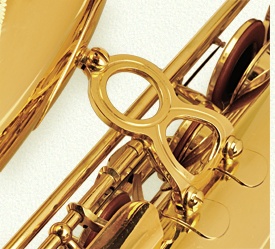
There are all the usual modern features, such as
a detachable bell, adjustable thumb hook (metal), a distinctive
triple-point bell brace and a large, plastic thumb rest - which
although flat has a rolled-off edge, so it's quite comfy.
I really like the bell brace design - it's a beautiful example of
a perfect marriage between form and function, being both visually
appealing and mechanically sound insomuch as it's designed to deal
with impacts from both the front of the bell as well as side on.
This is a belt-and-braces design, with an extra belt, and a bit
of string (just to be on the safe side).
Likewise the sling ring is both beefy and of a size
large enough to take a decent locking sling hook. This might seem
like a small point, but good sax slings are like good mouthpieces
- when you find one, you never want to let it go...and finding that
it won't fit your new horn is a bit of a disaster (to put it politely).
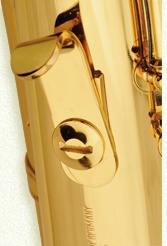 Continuing
along the same theme, the lock screw for the large metal thumb hook
is equally chunky, and looks to have been designed so that it can
be adjusted with the aid of a coin. I really like this idea - I
mean, think about it...when are you most likely to need to adjust
the thumb hook? Yeah, that's right, halfway through a gig just after
you got the horn. This is just about the time when you figure the
thumb hook needs to shift a tad more to the left - mostly because
your thumb is killing you and your fingers keep slipping off the
lower stack - and do you have a screwdriver handy? Well no, but
everyone's got a coin or two in their pocket, right? Like the sling
ring, it's another small point, but it makes a big difference. Continuing
along the same theme, the lock screw for the large metal thumb hook
is equally chunky, and looks to have been designed so that it can
be adjusted with the aid of a coin. I really like this idea - I
mean, think about it...when are you most likely to need to adjust
the thumb hook? Yeah, that's right, halfway through a gig just after
you got the horn. This is just about the time when you figure the
thumb hook needs to shift a tad more to the left - mostly because
your thumb is killing you and your fingers keep slipping off the
lower stack - and do you have a screwdriver handy? Well no, but
everyone's got a coin or two in their pocket, right? Like the sling
ring, it's another small point, but it makes a big difference.
Finishing up the body you have a set of adjustable
bell key guards, fitted to the body with reassuringly large stays.
This means they'll take a few light knocks in their stride, which
is exactly what you want on a pro-spec horn.
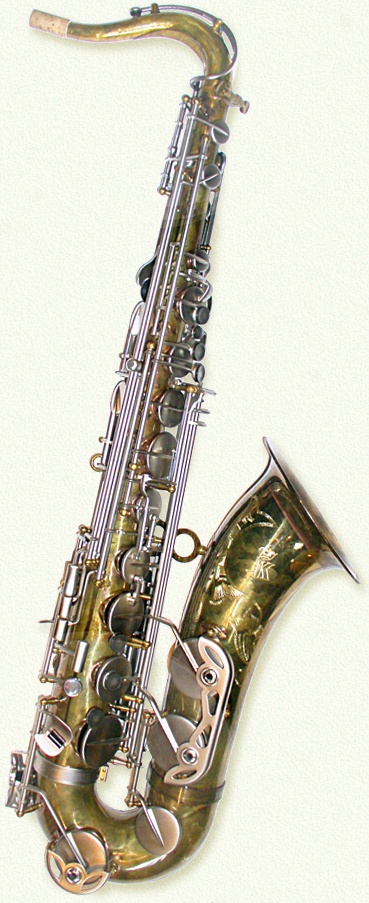
The finish on the model shown (the plain lacquer variant,
circa 2010) is very good - but I noted some finish issues on a nickel
plated lacquered model. This is an unusual finish, being a nickel
plated body with a coat of lacquer over the top. The nickel plate
is undoubtedly durable, nickel plate being extremely tough - though
lacquer will be lacquer, and may not be as durable.
However I'm not so sure the marriage is a happy one, I found the
finish to be slightly streaky with distinctly darker patches around
the fittings.
I also noted some file/machining marks on some of the keys. It's
a small point, I know, but at this price point I'd expect to see
a bit more attention to finishing details.
When it comes to the action, Keilwerth have pushed
to boat out to make the SX90R a distinctive horn, and perhaps the
first feature you're likely to notice are the curious key pearls
(these are proper mother-of-pearl). They're not so much seated inside
the key pearl holders as on them - and they're thick pearls too.
Personally I'm not sure that it works aesthetically - and from a
purely practical point of view it seems to me that it makes the
action feel slightly larger than it ought to be. On the plus side,
they're set at a forward angle - and there's a domed Bis Bb pearl.
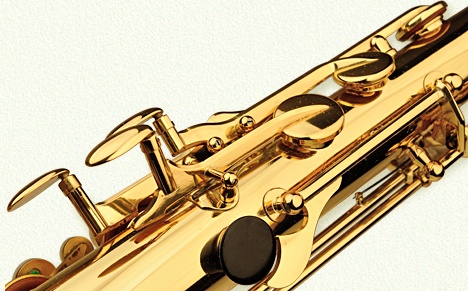 The
second feature you're likely to notice is the adjustable palms keys.
The bane of sax players has always been the relative height of the
palm key touchpieces, leading to all manner of gadgets and additions
to raise the keys to a level comfortable for the individual. Keilwerth
have recognised this dilemma and have incorporated an adjustment
into the palm key touchpieces which allows you to set their height
and the horizontal angle. Whilst I applaud this innovation I have
to say that I thought the design to be somewhat less than elegant,
which is a shame as this is a rather elegant horn otherwise. The
second feature you're likely to notice is the adjustable palms keys.
The bane of sax players has always been the relative height of the
palm key touchpieces, leading to all manner of gadgets and additions
to raise the keys to a level comfortable for the individual. Keilwerth
have recognised this dilemma and have incorporated an adjustment
into the palm key touchpieces which allows you to set their height
and the horizontal angle. Whilst I applaud this innovation I have
to say that I thought the design to be somewhat less than elegant,
which is a shame as this is a rather elegant horn otherwise.
I'm very much in two minds about this feature: on
the one hand it's great that you can adjust the height of the touchpieces
- it's something I'm asked to do all the time. On the other hand,
how big a need is it?
For most players who want the palm keys adjusted it'll be a matter
of a few millimetres. Five minutes with your tech will sort that,
and once it's sorted, it's sorted for good. Having the ability to
adjust these things at random might mean you're never happy with
them...and then there's the obvious downside that the keys look
damn ugly. There, I've said it.
I'm also less than taken with 'no stick' G' mechanism.
It's designed to make use of the power from the F# key as an aid
to lifting the G# key.
In normal use, and with a working G#, the arm does nothing at all
- but should the G# stick, the lever pivots on the stuck G# key
cup and makes contact with the Aux.F key cup. Once it does this
it tries to force the Aux.F key down - in effect using the spring
of that key to boost that on the G# key cup and supplying the upward
force at the pivot of the lever. In theory it's a sound idea - the
G# key pad is often notoriously sticky, and the larger the tonehole
rim, the more likely is it to stick (and remember, the SX90R has
very large tonehole rims - plenty more of which later).
 It
works, but boy does it look kludgy - and pretty much all of its
functionality could be duplicated with the simple addition of a
flat spring fitted to the G# lever arm. This is a mod that's been
kicking around since at least the 1960's - and can often be found
on many an old pro's Selmer MkVI. It
works, but boy does it look kludgy - and pretty much all of its
functionality could be duplicated with the simple addition of a
flat spring fitted to the G# lever arm. This is a mod that's been
kicking around since at least the 1960's - and can often be found
on many an old pro's Selmer MkVI.
And in spite of setting the lever up correctly I found there was
a slight delay before the G# cup came unstuck.
Still, a 'late' G# will be better than no G# at all - although most
horn players will habitually test the G# and low C# keys before
playing. If a stuck key is found it's a simple matter to just lift
it off with your finger, and thereafter it shouldn't trouble you
again for the duration of your gig/practice. If it does then it's
rather more likely to be an imbalance of springing.
A less-noticable, but nevertheless important, feature
is the chunky front top F touch piece. This thing is a brute in
comparison with other manufacturer's options. It's big, it's fast,
it's comfortable - that's all that needs to be said about it.
Similarly, the G# touchpiece is huge, as are the low C/Eb spatulas
- both clearly designed to accommodate a wide range of finger sizes.
Continuing this 'chunky' theme, there's an F# helper bar that's
simply a thick bar that extends off the F key cup. I've seen this
idea implemented in a number of ways on other horns, but it always
suffers from a degree of inbuilt flex - which renders the whole
idea a complete waste of time. Not so with the SX90R - the bar is
short and chunky, and if anything's going to flex it certainly won't
be this arm.
Likewise, the fork and pin connectors for the side Bb/C key are
plain, simple and wholly effective.
 Proper
bullet-headed point screws are used - and even better, the key barrels
have been reamed with matching tapered holes. Plain old holes would
have been sufficient, but Keilwerth have really pushed the boat
out here. Top marks. Proper
bullet-headed point screws are used - and even better, the key barrels
have been reamed with matching tapered holes. Plain old holes would
have been sufficient, but Keilwerth have really pushed the boat
out here. Top marks.
What this means for the player is that when the action wears (as
it inevitably will), it's a simple matter to tighten up the point
screws and take up the excess play. Tapered holes mean that there's
maximum contact between the key barrels and the point screws...which
ultimately means less wear.
On the negative side, there are no regulation adjusters
fitted to the main stacks.
I'll be honest - I really would have expected to see them on a horn
of this calibre. I realise there's perhaps a sort of snobbery (that's
possibly filtered down from high-end flute manufacturers) that says
'adjuster on the stack are for wimps', but out in the real world
they allow for fine play-and-test adjustments that can really make
a difference to a horn. You can certainly set a horn up 'by the
book', but you can only make it sing by playing and adjusting it
to even out the inevitable compromises - and that's where adjusters
earn their keep.
There's a decent set of pads fitted but some players
have had problems with stickiness. This'll be down to a number of
reasons, the most obvious being the wide tonehole rims - but there's
also the quality of the pad leather and the strength of the springs
to be taken into account. If you find it's an issue, check out the
article on sticking pads
for a solution.
And finally, the whole action is powered by blued steel springs.
In terms of feel, the SX90 series has always felt
a bit strange under the fingers to me. Much of this is undoubtedly
due to the placement and angle of the key pearls, but also the position
of the spatula keys.
While the bell key table is a superb design - smooth in action,
fast and responsive - it's placed a little too far down the horn
for my liking...and I haven't got particularly small hands, or short
fingers. Reaching the G# isn't a problem, or the low B/C# - but
getting the low Bb touchpiece seems like a bit of a stretch.
 I
also stumbled with the Eb key. In fast passages it was possible
to get my finger trapped between the Eb touchpiece and the underside
of the D finger button. It didn't happen every time, but often enough
to make me acutely aware of it. I
also stumbled with the Eb key. In fast passages it was possible
to get my finger trapped between the Eb touchpiece and the underside
of the D finger button. It didn't happen every time, but often enough
to make me acutely aware of it.
I can see what's happening - if you're playing a jump from, say,
E to Eb you instinctively press the D and the Eb key at the same
time. If the Eb key is ever so slightly ahead of the D key it's
possible to trap the tip of the little finger between the two. Naturally,
not every player will be affected by this - and even then it's perhaps
something that you'd learn to avoid - but in comparing the D key
with a Yamaha 62 tenor it can be seen that the Keilwerth's finger
button is a great deal closer to the bottom of the cup, and thus
very close to the Eb touchpiece when it's pressed down.
There isn't quite the precision feel of the Japanese
saxes, nor quite the fluidity of the Selmers...but a nice middle
ground with a responsive and fast feel - though it's worth pointing
out that having the action set up by your repairer will certainly
improve matters.
As for the ergos, I'm sure that these are things you can get used
to, just as I got used to the action on some of the vintage horns
I used to play.
As to the tone - well, I've spent quite a lot of time
playing these horns over the years and while I've come across examples
that have felt a bit lifeless, I've also found some that positively
oozed with fire and crackle. This'll be down to the individual construction
of each horn rather than any of that body material mumbo-jumbo,
and I'd certainly advise prospective buyers to take the time to
try a number of models before handing over the readies. This is
good advice no matter what make the horn is - but it's especially
relevant in this case.
After you've played quite a few examples of a particular
horn, you form an impression...an expectation - and my expectation
of the SX90R is this.
Tonewise it's a very rich-sounding horn, having a good balance between
the warmth and darkness you'd get from a vintage tenor and the punch
and clarity from, say, a Yamaha. There's quite a lot of midrange
response - and whereas I sometime find this to be a bit 'boxy' on
Selmers, the Keilwerth tempers it with a nice bit of glitter or
edge.
That glitter runs right across the range - and while it's great
at the top end of the horn I sometimes found it a little intrusive
down the lower end. It can be tamed though, with the right mouthpiece
or a tweak of the embouchure - and on balance I think I'd rather
it was there than not at all.
But perhaps the best feature is the response. It's a very easy horn
to blow, and one that's quick to respond to your input. For a good
player this means the horn is versatile, and it'll sing - but for
a less experienced player it can often mean the tone will vary considerably
over the range.
Being blunt, it means that if you sound crap on an SX90R it'll be
because you're a crap player - which is quite distinct from being
able to play the horn well enough, but not liking the tone.
At the end of the day it's a £3000 plus horn
- and at its best it plays like one. It's up to you to decide whether
it's what you want.
And now we come to the bit where it all goes to pot...
Keilwerth market this sax as having tone hole rings.
Although this gives the horn the appearance of having rolled tone
holes, true rolled holes have the lip of the hole rolled over and
tucked underneath to form a beaded rim to the tone hole - a practice
common on vintage American horns. Advantages include extra strength
to the tone hole and a wider seating area for the pad. Disadvantages
are that it's extremely difficult to level such holes in the event
of damage, and there is some justification to the point that a less
well defined tone hole rim makes for a less definite seal.
Keilwerth have compromised - the 'rolled' section is actually a
separate fitting, soldered onto the tone hole. This means it's possible
to remove and replace the rolled section, giving some of the advantages
of a true rolled hole and fewer of the disadvantages.
All good and well, but an examination of a number of these horns
showed that the tone holes (typically from low D down) were often
slightly warped.
Now, this is not an uncommon problem with cheaper horns, and is
easily remedied with a light dressing of the tone hole (more severe
warps require bringing up from beneath the tone hole). However,
these horns typically have straight tone holes - the addition of
a roll complicates matters enormously. Dressing a rolled tone hole
runs the risk of breaking through the roll, and even if this doesn't
happen it leaves an uneven surface area on the top of the tone hole.
On a professional level horn such an error is a grave manufacturing
defect - and a remarkable oversight given that Keilwerth fitted
the rolls separately.
Such errors can be compensated for by backing up the pads to match
the profile of the tone hole - but this is an expensive and skilled
procedure and is never as reliable as a true tone hole and a correspondingly
flat cup.
Last impressions then. Certainly an interesting horn, with some
very nice touches - but potentially badly let down by some serious
manufacturing defects. I'd want more for my money, and I'd strongly
advise potential buyers to take a packet of cigarette papers with
them when they try the horn - and check
those lower tone holes.
Additional notes:
Since this review was published, I have received much correspondence
and seen many comments about it dotted around the web. I think it's
worth reviewing those points here - if only to save me having to
re-write them time and again.
Surely no manufacturer would consistently turn out horns with
a defect - perhaps you're only seeing the worst examples?
It seems very unlikely that only the worst horns turn up at the
workshop. Indeed, the people who respond to my offer of a free check-up
often have no idea as to whether their horn is affected by the problem.
I've seen anomalies on horns by other manufacturers, and where serious
have advised clients to return the horn for replacement. Once you
get to the standard of the basic Yamaha horn, serious structural
or cosmetic defects are gratifyingly rare - and can be counted on
the fingers of one hand in as many years. The problem with the SX90R
horns has turned up on almost every* example (I
got up to twenty and stopped counting) thus far. How many do
you think I need to see before it becomes obvious that something's
not quite right?
I've seen reports of other examples from third parties, but in the
interests of accuracy I can really only comment on the horns I've
seen personally.
* I'm happy to report that I have now seen three examples with
level tone holes, as noted in the addendums below (November 2005,
December 2008 and January 2013), and a reasonable example in February
2015.
If people don't realise their horn has a problem, surely it's
not that serious?
It's what you're used to. Any repairer will have worked on horns
that have only come in for 'a bit of cork', and found leaks on the
bell keys. Having repaired those leaks and handed the horn back,
the client will often remark that they never realised they were
missing so much 'oomph' down the bottom end.
You compensate, and you become accustomed to it - but that doesn't
make it right or desirable.
I tried a number of horns out in the store - the Keilwerth beat
them hands down.
And so it might do - it is, potentially, a very nice horn. But
it comes back to what you're used to - and when trying out new horns
you'll be taking on board a whole package of new impressions and
sensations, and you may not realise that the horn is capable of
more than you're getting.
Bear in mind too that the problem represents 'trouble in store'.
New (and therefore soft) pads have a degree of accommodation in
them - once they start to harden up they'll be less and less able
to compensate for any anomalies in the tone holes. This could very
well take a few years, but it would be a repetitive cycle. You'll
be seeing a lot more of your repairer than owners of other makes
of horn. Keep in mind too that very few stores bother to set their
horns up - so you could well be comparing one leaky horn with another
leaky horn.
Didn't the old Conns have the same problem?
Conn saxes had proper rolled toneholes (see the accompanying
article for more details) and yes, they had their problems too
- but I've seen more Conns than I have Keilwerths and the problem
is nowhere near as endemic or severe. Those examples that have warped
toneholes will have exactly the same problems as any other horn
with the same fault.
It's also not an excuse. The Conns were built around seventy years
ago, and because the toneholes were properly rolled the manufacturing
techniques required were very complicated. It's now the 21st century,
manufacturing techniques have come on leaps and bounds - and the
Keilwerth doesn't even have proper rolled toneholes.
Hey, I'm happy with my Keilwerth!
I'm really pleased to hear that - and I hope it remains to be the
case.
Assuming a given quality of manufacture I can repair a horn, hand
it back to the client, slap my hand down on the workbench and promise,
even guarantee, that they'll be happy with it for a long time to
come. I can't do that with the SX90R.
I know a guy who says he's never come across this problem, nor
have any of the people he knows who have these horns.
Good for him - I'm delighted to hear it, but that makes him and
his friends the luckiest people on the planet.
Consider the statistics. There have to be tens of thousands of these
horns out in the marketplace, so the chances of coming across a
single anomaly should be reasonable enough. The chances of coming
across that anomaly twice should be quite rare. Three times, even
rarer still.
Once you get to four times, five times, six times etc. - the probability
factor is getting seriously phenomenal. Now consider the probability
of seeing those anomalies on consecutive horns...one after another,
from a random selection out of thousands and thousands of horns.
Am I really so fantastically unlucky that I've only seen the dregs
- or is this a consistent and repetitive problem?
And some people seem to take criticism of their horns rather personally.
I've seen comments ranging from complete dismissal of the problem
through to suggestions that even if there is a problem it really
doesn't matter. In one instance I saw a claim that all the horns
I'd seen had been mysteriously damaged in transit (that one made
me chuckle).
Don't be satisfied with glib brush-offs...ask the same questions
I've asked, read the accompanying article on warped
tone holes and weigh up the pros and cons for yourself with
the benefit of factual information and unequivocal proof.
My repairer has never heard of you, and I'm told that none of
the UK shops know you.
Does that make a difference?
Anyone can be shown how to diagnose a warped tone hole, you don't
need to be an engineer or a professional musician to see the problem
or to understand it. In any event I value my independence and take
great care to ensure that personal or business relationships don't
compromise it, no matter how illustrious the name.
I can see how a retailer with a stockroom full of SX90R's would
want to distance themselves from any hint of a problem - and if
someone expresses an opposing view you'd be well within your rights
to ask what their associations or interests might be.
I can get my low notes - surely my horn doesn't have this problem?
Just about any horn is capable of belting out the low notes. If
there are minor leaks you can compensate with extra finger pressure
and more air support. The real test is in playing subtone (that
lovely, soft, typically Getz sound), and with light finger pressure.
If you pick up a well maintained and regulated horn and blow subtones
around the bell notes, you should be able to do so with ease - and
with a very light touch. If you find you have problems you tend
to compensate subconsciously - in the same way that you will adjust
your embouchure to play in tune.
What this particular problem does is not necessarily stop the horn
dead in its tracks, rather it takes away a percentage of the tone
and volume (I reckon about 20%), which only comes back if you tighten
your grip on the keys. For many players this would be enough to
send them scurrying off to their local repairer. It's a fault, no
two ways about it.
How do I know you're being entirely honest?
Mainly because you're reading this article. This isn't a secret
document, hidden away from prying eyes - it's a public statement,
subject to public scrutiny...and legal scrutiny.
There's one beneficiary from the time and effort that goes into
these review pages - and it's you. On these pages you'll find plaudits
and put-downs in equal measure. I hold no allegiance, I simply report
on the evidence before my eyes without fear or favour. And I can
do that because I have the evidence. None of the horns reviewed
are figments of my imagination, they exist, they have been made,
bought and paid for - warts and all.
You seem rather over-concerned with this issue.
Keilwerth's tag-line is "Saxophones are our passion".
Guess what? Same here. I reckon any of my clients would be able
to attest to how much these amazing instruments thrill me. You can
see it for yourself - just pop along with a vintage beauty in mint
condition, or a unusual horn with an interesting history and you'll
see my eyes light up like a kid who's been given the day off school
and then found a fiver on the ground - right outside a sweetshop.
But it's more than that too. I take pride in my work, nothing beats
the satisfaction of coaxing the very best out of an instrument -
and defects such as those found on these horns make my job that
much more difficult, if not almost impossible,
And then there's the issue of you, the consumer, and your rights.
Nobody buys a Rolls Royce and then expects to have to put up with
wobbly steering at 70mph. I've always maintained that you get what
you pay for - and in this case I truly and honestly believe that
you're getting less than you paid for, and more than you bargained
for.
So what d'you reckon is going wrong?
A client was gracious enough to lend me a copy of Keilwerth's video
of their manufacturing process. Naturally I was very keen to see
it.
I think I see precisely what the problem is. The tone holes are
drawn very early in the manufacturing process - right after the
bell and the body are formed from the sheet. Directly after that
the holes are machined level and the tone hole rings are soldered
in position (and I am assuming here that the rings are level - I've
seen examples where the rings were badly fitted).
After that, the separate bell and body parts go through a whole
range of processes, whereby the pillars and fittings are attached,
the bell section is fitted to the body and finally the keywork is
matched to the horn before being sent off to the finishing department.
The whole thing is subject to a great deal of heat and manipulation
following the fitting of the rings - and it's only natural to see
how assorted stresses are imparted to the structure. This would
explain the gentle curves of the tone hole warps, as opposed to
the relatively sharp curves you'd see as a result of impact damage.
Now, I can understand the need to level off the tone holes and solder
on the rings early on in the process - it would be tricky to jig
the body parts up once the pillars and fitting are in place in order
to solder on the rings and dress the tone holes.
What's needed is an oversized tone hole ring - one that's, say,
3mm taller than currently fitted. This can be fitted as per usual,
early on in the process, and then dressed down with a suitably profiled
die fitted to a handheld machine after the pillars and fittings
are in place and the bell attached to the body. The extra height
of the tone hole rings would allow for any warp to be ground out
as the rings are brought down to their specified height.
Of course, it would involved some material costs - they'd need suitable
dies for every size of tone ring, and handheld drivers to power
them, and it would probably add about 30 minutes to the production
run - but the end result would be gloriously level tone holes.
That's really the only answer I can come up with for now - and this
assumes that the problem isn't due to the rings themselves being
warped prior to fitting...in which case the problem would be far
easier and cheaper to address.
Does this problem affect the SX90 - without the tone rings?
Not that I'm aware of - though I haven't 'officially' reviewed
one yet. Looking at the manufacturing process I would tentatively
suggest that there's a risk, but in any event it would be easy enough
to rectify permanently by conventional methods. From an entirely
personal point of view as a player I feel the rings add nothing
tonally anyway - and simply create more problems with regard to
sticking pads. Mind you, it's a moot point now - they no longer
make this model.
Have you told Keilwerth about your findings?
Yes, I've had correspondence with people at the factory and with
executives at the (now ex) parent company stateside.
In the former case they said they'd examine their manufacturing
process and report back to me. They apparently did so, but informed
me that they could find no problems.
The email I got from the parent company expressed concern at my
reservations, but thanked me for bringing the problem to light.
I have had no follow-up to my response, so I cannot say if any changes
in the manufacturing process have been made.
I believe that they're caught between a rock and a hard place on
this issue. If they were to admit that there is or was a problem,
then that would leave them open to every SX90R owner chucking their
horns back at them.
If they don't admit to it, but subsequently claim something like
'improved tone hole accuracy' then that leaves them pretty much
in the same boat.
The only commercially viable option is to say nothing and quietly
resolve the manufacturing issue.
That being said, the addendum added in August 2004 points up yet
another problem with the tone holes.
Are you sure it's a manufacturing issue? Couldn't the horns
have got damaged somehow?
If the warps were a result of damage there'd be collateral evidence.
If your horn took the kind of knock that could distort a tone hole
then there'd be a corresponding distortion to the body. Such damage
would be clearly visible - you can see what it would look like on
the photo of the copper belled horn below. Another way of distorting
tone holes is by bending the body of the horn - but this too would
be highly visible, and tends to occur around the G-F tone holes
(sax bodies typically get bent around the mid section). A bend on
the bottom bow would be highly unlikely - the sort of force required
to do that would result in a crushed bell.
Would you ever say if you'd seen one without warped tone holes?
Yes, as I have done.
Have you ever managed to fix one?
Yes, I've been able to address the issue on a number of examples
that weren't too badly affected - and the difference it made was
significant. Success depends on where the warps are and how deep
they are...there's only so much I can do. Over the years I've been
working on new techniques and custom tooling and can pretty much
sort out all but the very worst examples without too much fuss.
Maybe you just don't like Keilwerths.
I'll admit they're not my horns of choice, but then neither are
many of the horns that get reviewed on this site...and most of them
manage to get a decent enough write-up.
I don't have to like a horn in order for it to be a good one - the
web is awash with 'reviews' by players who feel their horn is the
best - but any half-decent player knows that it's all down to personal
preference. Because such things are personal my reviews focus on
the mechanics.
In any event, I awarded an SX90R my 'horn of the show' in my 2008
Frankfurt Musik Messe report
Years have passed since you last saw a Keilwerth with tonehole
problems - what are they like now?
The most recent models I've seen (as of 2013 - see addendums below)
have been fine. If they maintain that level of build quality there
should be no problems at all.
Addendums
I like to base my reviews on a number of examples of any given
make/model of instrument, and where I find exceptional problems
on later examples I'll post an addendum to the original review.
In the case of the SX90R the problem is significant enough to warrant
an addendum for almost every example that comes in - and they're
listed below in order of date of build.
Addendum:
Build date - 1997: Review date - September 2008
 A
chance to examine a very early SX90R - this one bearing a 106xxx
serial number, bought new in 1997. A
chance to examine a very early SX90R - this one bearing a 106xxx
serial number, bought new in 1997.
As far as tonehole issues are concerned, this example wasn't too
bad - though it still had some problems on the low C/B and Bb tone
holes. Seen here is the low B tonehole showing a warp that affects
about a third of the area of the tonehole. The low C tonehole was
about as warped, the low Bb slightly worse with gaps showing on
both sides.
What was particularly interesting about this horn was that it
had been serviced a little while back and a number of pads had been
changed in an effort to remedy the horn's reluctance to speak clearly
and accurately. Unfortunately no effort had been made to address
the tonehole warps, either by tackling the toneholes or backing
up the pads - and it was possible to note multiple failures of the
cigarette paper test.
Given that the latest model seen with such problems was built in
2007, and this one dates from 1997 - it amounts to an issue that
spans a whole decade. Happy Anniversary.
Addendum:
Build date - 2002: Review date - December 2002
I have supplemented this review with an article dedicated to the
issue of warped tone holes, which explains in more detail the nature
of the problem - and contains further details specific to the SX90R.
It can be found here.
I have recently examined an alto variant of this model, with the
black nickel plate finish.
Regrettably I found the same old tone hole problem. This is particularly
disconcerting on this model as any attempt to level the holes from
the top down would destroy the finish on the tone hole tops.
Even more disconcerting is that fact that this instrument is barely
four months old...so the tone hole problem remains an issue.
The review of the tenor corresponds to my feelings about the alto
- though I will add that the black nickel finish looks gorgeous!
Addendum:
Build date - 2003: Review date - July 2002
I had a client bring in a tenor, bought new in February 2003 which
exhibited the same tone hole problems as detailed above. In this
instance the low C and C# tone holes were affected - with the C
showing gaps at the top and bottom of the hole, and the C# showing
a gap at the top of the hole.
Lovely brushed nickel plate finish on the body though, very distinctive.
Addendum:
Build date - 2000: Review date - August 2003
I have recently examined another tenor - built in 2000, a special
'Anniversary' model.
Again it exhibited the tone hole problem, specifically on the low
C, B and Bb holes, with the warp on the low Bb being quite severe.
I felt this model had far more 'zing' than the others I've seen
thus far, particularly on the low notes (when they worked).
Addendum:
Build date - 2000: Review date - March 2004
 And
yet another example comes under scrutiny - an Anniversary 'Edition
75' tenor, built around 2000, with a black nickel plated body and
silver plated bell and keys. Looks very nice - but once again the
toneholes exhibit the same old problem. The low C and Bb in particular
were really quite badly warped. And
yet another example comes under scrutiny - an Anniversary 'Edition
75' tenor, built around 2000, with a black nickel plated body and
silver plated bell and keys. Looks very nice - but once again the
toneholes exhibit the same old problem. The low C and Bb in particular
were really quite badly warped.
Here's the low C - there's a substantial dip at both the front and
the rear of the tone hole.
Might not look much, but bear in mind that a serious leak is one
that you can slide a cigarette paper into...you could get a bit
of card into these gaps!
Addendum:
Build date - 2002: Review date - August 2004
My offer to examine SX90R horns brings in another example - this
time a horn in the 109xxx (purchased new around 2002) serial number
range. This model features a copper bell and crook with standard
brass body and keywork. Very nice it looks too.
On my initial examination I really thought I had at last found an
example without the tone hole problem - and this proves how hard
it can be to spot the anomaly in amongst the curves and reflections,
because when I placed the  test
die over the low B tone hole I found a pretty major warp. test
die over the low B tone hole I found a pretty major warp.
In this case it begins just left of centre of the tone hole, with
its apex at the extreme right. A particularly difficult one to spot,
given that as you look down the bell with the cup closed it doesn't
show a leak on the lower portion of the pad.
Of more interest (to me, at any rate) was another anomaly I spotted
on the G# tone hole. Have a look at the picture below.
Note the arrow, which points to the rim of the drawn tone hole.
The tone ring is fitted onto the tone hole - and if you assume that
the parent tone hole is level, then if follows that the ring ought
to sit flush on the rim of that hole.
But look just above the arrow and you can clearly see a gap inbetween
the rim and the lip of the ring.
Note too how the gap decreases away from the arrow - which means
the tone hole ring has a rise in it.
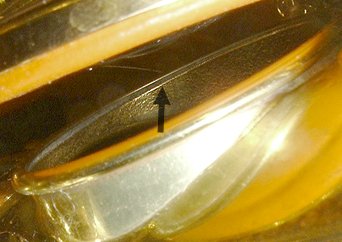 So
what's going on here? Up until now, and confirmed by what I've seen
in the manufacturer's video, I've assumed that at some point the
parent tone holes have been levelled off - and that warpage appears
to be caused by stress imparted to the body later in the build process.
But this picture indicates that there's yet another potential problem
- that of the tone rings being incorrectly fitted in the first place. So
what's going on here? Up until now, and confirmed by what I've seen
in the manufacturer's video, I've assumed that at some point the
parent tone holes have been levelled off - and that warpage appears
to be caused by stress imparted to the body later in the build process.
But this picture indicates that there's yet another potential problem
- that of the tone rings being incorrectly fitted in the first place.
As you can imagine, having the tone ring sticking up in this fashion
completely destroys any hope of the tone hole being level - and
this on the G#...one of the most critical tone holes on a saxophone.
I'd expect better - and if you've forked out several thousand for
such a horn, so should you.
 Something
else caught my eye too - take a look at this shot of the low Bb
tone hole. There's a crease just under the rear of the hole, as
shown by the curved reflection about a centimetre from the base
of the hole. Something
else caught my eye too - take a look at this shot of the low Bb
tone hole. There's a crease just under the rear of the hole, as
shown by the curved reflection about a centimetre from the base
of the hole.
I wondered how that might have got there.
I tend to assume that any structural damage is down to the owner
- but just how would you push a crease like this into a horn? Bear
in mind that the Bb key cup sits over this hole, as well as the
low B/Bb key guard.
To make a crease like this the owner would have had to crush both
the guard and the key cup hard down onto the tone hole - and at
the rear of the key cup too. Naturally such an impact would do a
great deal of damage all round, but none of this was in evidence.
Oddly enough, the low Bb tone hole was level - but I wonder if it
started off uneven and had been given a 'tap' at some point to bring
the rear of the hole down?
I shall be looking out for more examples of this particular 'fix'
in future.
As for the blowing - pretty much the same as the other examples,
although this horn had a nice crackle to it - perhaps more due to
the copper neck than the bell, and although it blew all the way
down to the low Bb you could still eke out a good 20% or so more
tone by squeezing the keys hard against their tone holes.
The owner hadn't played this horn much since purchase, so the pads
were pretty much as new - but as time goes by the G# in particular
is going to cause some considerable problems.
There is a possibility that the warp in the low B can be corrected
by raising the body underneath the tone hole - which would leave
a hump to match the removed crease on the low Bb.
Addendum:
Build date - 2000: Review date - February 2005
An Anniversary Edition 75 alto finds its way into the workshop.
This time it gets a full
review, and whilst it's about the best example I've seen in
terms of the tone hole issue, it still fell on a very warped low
C.
Addendum:
Build date - 2003: Review date - November 2005
A solid nickel silver bodied alto turns up on the workbench - and
becomes the very first example of the series I've seen without the
dreaded tone hole problem. Read all about it here.
Addendum:
Build date - 2003: Review date - December 2008
 This
example, bearing a 111xxx serial number, dates from around 2003
at a rough guess and receives the accolade of perhaps the worst
example of a warped tonehole I've seen to date, beating even the
model reviewed on 20/06/07. The client 'noticed some difficulty'
in getting the low notes. This
example, bearing a 111xxx serial number, dates from around 2003
at a rough guess and receives the accolade of perhaps the worst
example of a warped tonehole I've seen to date, beating even the
model reviewed on 20/06/07. The client 'noticed some difficulty'
in getting the low notes.
The overall setup was poor too, with many cups at the wrong angle
which meant the pads were contacting the rear of the toneholes first
and leaking at the front. I spent a good hour tweaking cup angles
and resetting pads just to get the horn in reasonable blowing order.
The client the told me it had recently been serviced by a major
London shop and the bill had been in excess of £150.
I don't know what's more disgraceful - the state of the tone hole
shown or the appalling service job...
Addendum:
Build date - 2004: Review date - January 2007
Another nickel-bodied alto arrives in the workshop - but unlike
the previous example it exhibits problems with a couple of the tone
holes. I have added it to the alto review here.
Addendum:
Build date - 2004(?): Review date - October 2022
 This
tenor - with a serial number in the 115xxx range (estimated to be
from around 2004/5) - was a bit of a bargain. The story is that
a chap bought it for himself as a 50th birthday present with the
intention of learning to play it - but other interests overtook
him and the poor old sax was stuffed into a cupboard and pretty
much forgotten about. It came onto the market recently and was snapped
up at a price I won't reveal...because it'll turn you green with
envy. Suffice to say this was a minty fresh, barely used standard
Vintage SX90R for a good deal less than half the price of a new
one. This
tenor - with a serial number in the 115xxx range (estimated to be
from around 2004/5) - was a bit of a bargain. The story is that
a chap bought it for himself as a 50th birthday present with the
intention of learning to play it - but other interests overtook
him and the poor old sax was stuffed into a cupboard and pretty
much forgotten about. It came onto the market recently and was snapped
up at a price I won't reveal...because it'll turn you green with
envy. Suffice to say this was a minty fresh, barely used standard
Vintage SX90R for a good deal less than half the price of a new
one.
The client who brought it in had seen this review and wanted me
to examine the horn and fix any issues. And there were quite a few
of them. All of the toneholes bar one (the low F) exhibited noticeable
warps. Of these I'd say about a quarter of them were just about
passable if you squinted a bit - and the rest were just plain awful.
The low C in particular was outstandingly bad - possibly the worst
I've ever seen. That gap measures 0.4mm - and there's an almost
equally large gap around the other side.
A playtest prior to fixing it showed that the tone and response
pretty much petered out after G unless you used the old gorilla
grip.
It took four hours to flatten the toneholes and the results were
spectacular. Perfect, immediate response all the way down - and
bags of that big, fat Keilwerth tone. And still at less than half
the price of a new one. Can't complain about that.
Addendum:
Build date - 2006: Review date - April 2006
A brand new standard SX90R (118xxx) is brought into the workshop
for a checkover and setup.
This example was much improved over the earlier versions I've seen,
though I regret to say I still found a few issues worthy of comment.
 The low Eb tone hole was slightly warped, with a gap of about 1
millimetre at the front and rear of the pad.
The low Eb tone hole was slightly warped, with a gap of about 1
millimetre at the front and rear of the pad.
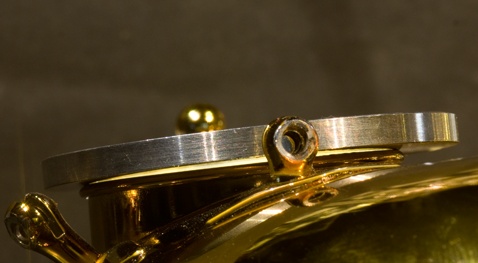
The reason for this warp is an incorrectly fitted tone hole ring,
as can be seen on the photo on the left.
See that grey band just below the top of the tone hole? That's the
side of the tone hole ring, and the grey band marks out the discrepancy
between the top of the tone hole base and the lower part of the
tone hole ring.
Had this ring been fitted correctly the tone hole would have been
level.
Fortunately, the Eb pad is always held closed by its spring - so
this discrepancy won't be too critical an issue for as long as the
pad is in good condition. Trouble is, the Eb pad takes a lot of
punishment in terms of moisture and gunk - and it will be necessary
to change this pad more frequently than on a horn with a level Eb
tone hole.
The low C tone hole was fractionally out, but I felt it was within
reasonable tolerance after a slight dressing. It needed a dressing
too, there were a couple of rough spots on the surface. It'll be
fine, but it's still less than perfect.
 Another
place that had imperfections was the palm key tone holes. My attention
was drawn to these by excessively heavy springs - and in order to
back off the spring tension I had to remove the palm keys. I also
had to address the problem of a seriously sticky top F key pad (so
sticky that the front F mech failed to open it). Another
place that had imperfections was the palm key tone holes. My attention
was drawn to these by excessively heavy springs - and in order to
back off the spring tension I had to remove the palm keys. I also
had to address the problem of a seriously sticky top F key pad (so
sticky that the front F mech failed to open it).
Upon removing the keys I noticed the F and E tone holes had burrs
inside (can be seen here as a rough white arc inside the tone hole).
The reason for the F sticking was the pad fouling in the tone hole
burr. All that was required to remedy this was to remove the burrs
with a fine file before smoothing over the bore of the holes.
In terms of improvement to build quality I'd rate this example
as an 8 or 9 out of ten - though it's lucky that the badly fitted
tone hole ring was on the Eb key. Had it been the low D or C it
would have been a far more serious issue.
Overall though the quality control is still not up to the standard
I would expect to see on a horn in this price bracket.
Once set up the horn blew very nicely. The balanced combination
of a rich, warm tone coupled with a nice touch of edge makes this
a very versatile tenor that will respond nicely to a wide range
of mouthpieces. Without suffering the vagueness of earlier examples
with more severe tone hole problems, the lower notes spoke with
more immediacy and authority.
I still feel the action feels slightly large under the hands, and
on this model the bell key action felt ever so slightly more sluggish.
This would appear to be down to the fitment of a spring to the unusual
G# anti-stick mechanism. It's a small point, but having felt a great
many excellent bell key mechs I think I'd be inclined to remove
the spring to put back a bit of snap into the action here.
So, a bit of improvement then, but still a disappointment to find
quality control issues on a top-level horn - and as such I can still
only recommend this horn with caution.
 Addendum:
Build date - 2006: Review date - January 2007 Addendum:
Build date - 2006: Review date - January 2007
The latest example on the bench is a 'Vintage' model - so called
because of the distressed finish to the plain brass body, similar
to that seen on the Borgani
Ponzol, whereby the body is 'dirtied up' and then lacquered.
It has the effect of making the horn look instantly old, and ensuring
it stays that way and doesn't get any grubbier (where's the fun
in that though?).
This model (serial number range 123xxx) was bought new in Dec.2006.
It doesn't look too bad, though probably not to everyone's taste,
and the brushed matt finish on the keys certainly helps to make
this a very distinctive looking horn.
From my initial inspection I suspected that what problems there
were with the horn was due to poor action setup. Several keys were
badly regulated, which caused leaks due to pads being held off closing
by linked action.
This made the lower subtone notes insecure, and although the horn
didn't sound too bad it lacked the zing it should have.
 Tweaking
the action helped matters greatly, particularly slackening off the
excessive spring tension on the main stacks and bell keys - but
a warp was found on the low C tonehole. Although a double warp (photo
left, warp on left side of tonehole hidden), it wasn't as bad as
those I've seen on previous models - and I would be tempted to say
that this bodes well were it not for the recent alto model that
shows a step backwards in terms on tonehole integrity. Tweaking
the action helped matters greatly, particularly slackening off the
excessive spring tension on the main stacks and bell keys - but
a warp was found on the low C tonehole. Although a double warp (photo
left, warp on left side of tonehole hidden), it wasn't as bad as
those I've seen on previous models - and I would be tempted to say
that this bodes well were it not for the recent alto model that
shows a step backwards in terms on tonehole integrity.
An adjustment was made to the tonehole which helped to lessen the
degree of warp, and this, along with an adjustment to the pad seat,
really improved matters for the subtone notes.
Once blowing properly it was possible to fully appreciate the richness
of tone throughout the horn, and the playful edge to the lower notes
As it stands, this horn represents an improvement, but I still
find manufacturing defects of this nature unacceptable on a top-flight
horn - and I shall keep watching...
 Addendum:
Build date - 2006: Review date - March 2008 Addendum:
Build date - 2006: Review date - March 2008
This SX90R Shadow bears a serial number of 121xxx, which places
its build date somewhere in 2006 at a rough guess.
When this tenor arrived in the workshop it was barely working at
all - it was a real struggle to get much below low F, and naturally
I assumed it would be a problem with the tone holes.
But I was wrong (pretty much), because although this horn had a
couple of tonehole issues the chief problem was the state of the
action.
Practically every single key cup on the main stacks was at the wrong
angle, resulting in the pads bedding down at the rear - which leaves
a leak at the front.
Now, this horn has been in use for a couple of years - so I can't
really point the finger at manufacturing problems, but I will say
that such problems rarely come about of their own accord (unless
someone has taken a mallet to each and every key cup and given it
a healthy whack) - and that I've seen the same issue on quite new
examples.
The problem is indicative of a pad that has been compression set
- it's been placed in the cup and then forced closed against the
tonehole, rather than heated and manipulated to lie level.
Pads set by compression tend to expand and thus lose their seat
at one end or other of the tonehole - and the only fixes are to
have the pads reset (or the cup angles adjusted) or use those dreadful
key clamps to maintain the
compression seating when the horn is in its case.
Because this horn played so badly the client was able to purchase
it for a knockdown price (I won't say what it was, it would bring
tears to your eyes) - but then discovered that the reason it played
so badly might be down to warped toneholes...hence a nail-biting
visit to my workshop!
And yes, it did have warped toneholes - but only a couple, and
fortunately neither were so bad that they either couldn't be levelled
or compensated for with a backed-up pad.
The biggest problem was the low D tonehole, with a slight warp to
the front and the rear. Because of its proximity to the bottom bow
joint it wouldn't be advisable to attempt to rectify matters by
lifting the bore or tapping down the tonehole sides, so I opted
for fitting backing wedges to the underside of the pad to take up
the discrepancy. It took a while to get it just right, but it's
a substantially cheaper solution than having to whip the bell off
to remake the bottom bow joint seal. Not as permanent, mind you
- whoever replaces that low D pad will have to ensure they shim
it to match the profile of the tonehole rim.
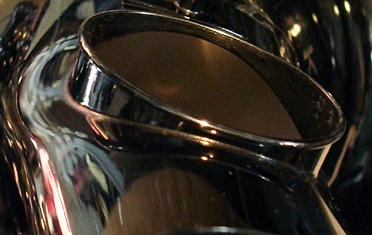 Of
more concern was the low Bb tonehole. Of
more concern was the low Bb tonehole.
You can see to the rear of the tonehole that the body is clearly
dented (note how the light curves around the base of the hole).
I've seen this before, on the copper-belled model reviewed in 2004.
There's really only one way to get a dent like this in the body,
and that's to give the tonehole rim a whack. Because of the placement
of the key guard it's all but impossible to do this kind of damage
accidentally - and in any case, if you did you'd warp the tonehole.
As it happens this tonehole was level from front to back - which
suggests that this dent has been deliberately made in an attempt
to address a warped tonehole.
It almost worked - I had to raise the hole very slightly on the
bell rim side to fully level it.
It still has to be said, a fix like this is unacceptable on a top-end
horn.
Once the keywork issues had been addressed, and the tone holes
accounted for, this horn blew as sweetly as any of the very best
tenors I've played. The client, considering the price he paid for
it, was over the moon. So was I, to be frank.
Note definition was superb - every single note had a nice sparkle,
but there was also a deep richness there too. It almost felt as
though there were two horns playing...one bright, one warm - and
this carried on through right across the range.
I would say though that at subtone that sparkle was a little intrusive,
and in a side-by-side test with a Yamaha YTS62 the Yamaha actually
sounded warmer at subtone. Not by much, I grant you, but enough
to surprise me. This was on the same mouthpiece though, and I would
think that a larger chambered piece would quell that slight brightness
if it wasn't to your liking.
It's an effortless blow too - very free-blowing and responsive,
and I think for the very first time I actually enjoyed playing one
of these horns. I still feel for me that the design and layout of
the action makes the horn feel big under the fingers, but that's
something that individual players will either like or not.
What's particularly frustrating about this example is that it shows
what these horns are capable of. I can combine that comment with
my recent experience at the Frankfurt Music Messe this year (2008),
at which I snuck onto the Keilwerth stand and gave their horns a
good blow. They were featuring a 20th Anniversary Shadow with a
solid silver crook which was just gorgeous to blow (I checked the
toneholes visually, they looked OK) - perhaps one of the best horns
at the show.
Contrast that with the previous addendum - the horn so bad that
it got sent back to the manufacturers.
This is what's so frustrating, it's obvious that these horns are
good...great even...when they work - but someone, anyone, at Keilwerth
has to recognise that consistently good build quality is demanded
and expected at this price level.
Let's not forget too this latest addendum example had build issues
too (fortunately largely correctable) - and as such I do have to
mark it down as a fail in terms of build quality.
Addendum:
Build date - 2007: Review date - June 2007
Now this is interesting...this next SX90R to arrive in the workshop
(bought new in May 2007) is the same model as the one reviewed above
- the 'Vintage'. This horn bears a serial number of 123xxx - and
is approx 450 horns later than the model above.
If you make the natural assumption that the more horns Keilwerth
make - the better they should be at it, then this model should be
an improvement on the previous example.
 In
fact this particular horn was the worst example I have ever seen.
The reason it came into the workshop was because it barely blew
much below low D - and here's why. In
fact this particular horn was the worst example I have ever seen.
The reason it came into the workshop was because it barely blew
much below low D - and here's why.
This photo show the low Eb tone hole; note the cavernous gap on
the right hand side. There's another gap on the other side, though
it doesn't show up on the photo.
This is bad enough, but this isn't even the half of it.
Not only was the low Eb tonehole completely out of true, so was
the low C, and the low B...and the low Bb - and by a considerable
degree. I didn't even bother to check the C#, or any holes above
the Eb...there didn't seem to be much point.
When it came to deciding which tonehole anomaly to display I was
quite literally spoilt for choice.
Bearing in mind that this horn was bought mail order (from Germany)
I examined the horn carefully for transit damage. None was evident
- the defects found were built in at the factory.
 Leaving
the build quality aside for a moment, I was rather taken aback by
the overall finish of the horn. Leaving
the build quality aside for a moment, I was rather taken aback by
the overall finish of the horn.
The 'pre-distresssed' finish has been around for some time now -
and whilst I'm not particularly a fan of it, I can at least appreciate
how some players would find it appealing...but I have to question
where the line is drawn between a deliberately 'funky' finish and
just plain sloppiness.
The photo on the right shows the bell section of the horn. Note
the black splashes around the key guard stay and bell stay plate.
These are what's left of flux/solder residues after the body has
been dipped in a cleaning solution. You can clearly see what's called
a 'wipe mark' to the left of the key guard stay...where the builder
has wiped the soldered joint with a cloth to remove any excess solder.
I call these 'witness marks' - they point up areas of repair.
If it were the case that an ordinary horn needed a parted stay resoldered,
this is how the job would look immediately after the stay had been
resoldered in position (though many a repairer would have made rather
less mess) - and subsequent to the resoldering the area in question
would be cleaned and polished.
There are marks like this all over the horn, and much as I like
to be objective about esoteric finishes I feel that in this case
someone is taking the piss - it's really not a nice finish at all.
A 'vintage' finish should be about treating the brass to make it
look old and worn - if your old and much-loved Selmer came back
from the repairer with these kind of witness marks you'd probably
have a blue fit.
I did try to play the horn - if only so I'd have something good
to say about it in the write-up - but it really wouldn't blow very
well...the setup was absolutely atrocious.
I ended up advising the client to send the thing back on the grounds
that it was a complete and utter disgrace - and recommended that
if he wanted to buy a sight-unseen horn then he'd better stick to
something from Japan...or get himself off to a decent music shop
and spend a day trying out horns.
He did send it back, and the seller's technician agreed that the
horn was awful and a full refund was made. He subsequently spent
a day trying out horn in a shop and came away with a Selmer Ref.54
(so he's not completely out of the woods yet).
So where does this leave the SX90R in terms of quality control?
I really had hoped that as time went by the manufacturer would address
the issue of warped tone holes, but with this very up-to-date example
being the worst I have ever seen it looks like there's been a step
backwards, if anything.
I find myself applying the term Caveat Emptor to a horn that costs
over £2000...and that's an appalling state of affairs.
I'm told that production is moving to a new factory shortly. I'm
not holding my breath...
 Addendum:
Build date - 2008: Review date - December 2008 Addendum:
Build date - 2008: Review date - December 2008
This brand new (as of November 2008) Anniversary Shadow tenor (serial
124xxx) looks very impressive, with its black nickel body, solid
silver crook and bell. I played one of these at the Frankfurt
Music Messe earlier this year and felt it was perhaps the best
playing tenor there - so I was extremely keen to get one on the
workbench for a thorough inspection.
As it happens it was one of two possible horns that might have found
their way here, but the other example the client tried out in the
shop failed to work at all - which wasn't very encouraging for such
an expensive horn.
Given the previous record of SX90R horns the first thing I checked
was the integrity of the toneholes.
I'm delighted to say that they passed muster! I found a couple of
very slight gaps in two toneholes when testing against the die,
but not of sufficient size to cause any undue concern (which perhaps
puts into perspective how bad some of the previous examples have
been).
It's not all good news though, there were a number of very significant
leaks from the pads - including a very large leak from the top B
key pad. I did the cigarette paper test and had the client tug on
the paper so that he could clearly see how one side of the pad completely
failed to grip the paper.
There were similarly serious leaks on the entire right hand key
stack (all the pads leaked at the front, which points to incorrect
cup angles/pad thickness) and a very noticeable leak on the rear
of the low B pad.
Because the toneholes were level it was relatively easy to correct
these errors - but on a horn of this quality and price they should
not have been there in the first place. I know most, if not all,
horns will benefit from a setup from new, but these kind of issues
shouldn't be seen in this quantity at this price level - and perhaps
explains why the other horn in the shop failed to work at all (the
client subsequently wrote to Keilwerth to express his surprise that
such an expensive horn should be allowed to make the showroom in
this condition).
Once fixed up the horn blew very well indeed. Tonewise I would
liken it to the difference between the Yamaha 62 series and the
Z series - essentially the same tone as the cheaper model, but a
bit more of everything. I think existing SX90R owners are unlikely
to be tempted by it en masse, but new buyers might well be persuaded
to fork out the extra over the standard models.
On the basis that I found no manufacturing defects on this model
I feel I can cautiously recommend it - but with the caveat that
you'll very probably need to have it properly set up.
You should also continue to check for tonehole problems, you'll
see from the timeline of the reviews above that a decent example
is no guarantee at all that the next horn off the production line
will be as well built.
Addendum:
Build date - 2009: Review date - February 2011
 A
Shadow (124xxx) is brought in for a checkover. A
Shadow (124xxx) is brought in for a checkover.
This horn was bought around two years ago, and as the client also
had a Shadow alto he felt it was worth making the long trip over
from Bristol to take advantage of my 'inspect and oil' offer.
I hesitate to say I found no significant problems - because the
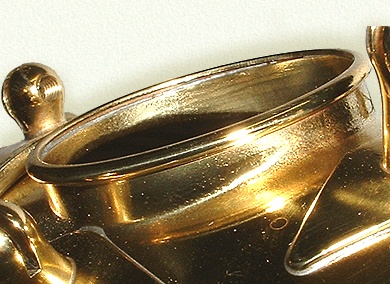
photo on the left shows the upper side of the low Bb tone hole...and
there's a distinct line between the rim of the tone hole and the
soldered-on tone hole ring.
That shouldn't be there...the ring is designed to fit on top of
the tone hole. It hasn't been filed either, as the tone hole rim
is ever so slightly lower than the ring.
In terms of playability it represented no problem - but in terms
of quality control at this price level it's not great. The tone
hole itself had a very slight warp, with a dip in the upper and
lower sides - but this was easy enough to correct with a very slight
lift to the bore.
The horn was blowing well enough when it came in, with just a very
slight lack of solidity on the low Bb. The tone hole correction
sorted it a treat and gave the low note just a little bit more zing.
Addendum:
Build date - 2010: Review date - February 2015
I had plain lacquered model in for a service, with a serial number
in the high 125xxx range. At a rough guess this dates it to around
2010/11...which would be around or just after Buffet acquired Keilwerth.
I found no 'serious' warps to the toneholes, though
the low Bb/B/C# and C toneholes all had slight dips at the front.
These were not visible and only showed up when tested with a flat
standard - and to be fair I've seen this sort of thing on other
pro-quality horns.
It's still not perfect, but it's just about within the capacity
of the pads to accommodate the small discrepancy.
I wanted perfection (the horn deserves it), so these holes received
a very light dressing and the pads were reset - but before I did
so I corrected a few small issue with the main stacks (just general
wear and tear) and gave it a blow.
It certainly blew all the way to the bottom, but from the low C
down it lacked the grunt and punch I'd expect from these horns -
even with a moderately hard finger pressure. Once the slight warps
had been dealt with, the horn sang all the way down.
 Addendum:
Build date - 2012: Review date - January 2013 Addendum:
Build date - 2012: Review date - January 2013
It's been a while (at the time of writing) since I had the
time to do an update to this long-running review, and in that time
the Keilwerth factory has undergone a number of changes. For a while
it looked like there was some doubt as to whether this distinguished
marque would survive, but with the acquisition of the company in
late 2010 by Buffet it would appear that all is well. It would also
appear that someone in the company bought a new broom and gave the
factory a bit of a once-over.
How so?
Well, this is a brand new SX90R Shadow (serial 126xxx) - ordered
late 2012 and delivered to the buyer barely a week ago. It's about
as hot-off-the-press as it gets. And it's perfect.
Well, OK, it needed a couple of keys realigning and a spot of double-action
dealing with - but as it was a mail-order purchase I think it's
only fair to put that down to a spot of jiggling in transit.
The big deal is that the tone holes are level. All of them. Spot
on.
About bloody time too!
Now, I've been here before. Having announced (with genuine pleasure)
that I've seen an SX90R with good tone holes, and suggesting that
it may herald a new era of improved quality-control, I've later
found myself disappointed to find the same old problem cropping
up on later models.
This time it's different. I am led to believe that some changes
have been made at the factory - and whether that means they've bought
the quality-control inspector a new pair of glasses or are horsewhipping
the builders every hour, I don't really care. Just as long as every
horn they turn out is like this one.
 I'm
also wondering if they've made a few minor changes to the action,
because it feels like a more cohesive package; these horns have
always felt a bit 'industrial' to me - possibly due to the Heath-Robinson
anti-stick G# mechanism - but this one felt smoother and creamier
under the fingers. I'm
also wondering if they've made a few minor changes to the action,
because it feels like a more cohesive package; these horns have
always felt a bit 'industrial' to me - possibly due to the Heath-Robinson
anti-stick G# mechanism - but this one felt smoother and creamier
under the fingers.
It may well be down to a better overall build quality, but whatever
it is (even if it's my imagination) I like it.
I still find it's worth setting the springs just a tad harder than
normal, just to alleviate the tendency of the pads to stick to the
wider tone hole rims.
The client who brought this horn in wanted to know whether he should
keep it or send it back - and there was a certain amount of holding
of the breath as I examined the tone holes. Understandable really
- the small leaks due to transit affected the playability of the
horn in exactly the same way that warped tone holes would.
So I was delighted to be able to tell him it was a keeper - and
better still, that if I were going to keep an SX90R, it would be
this one. It sings like a bird up top, and growls like a tiger down
the bottom.
Naturally, I'm going to continue to keep an eye on this model -
but as it stands at the moment I'm going to give 'New Improved Keilwerth'
the benefit of the doubt and give them the official thumbs-up on
this model.
Perhaps this Shadow will lead them out of the shadows.
Addendum:
Build date - 2012: Review date - September 2018
Another 126xxx Shadow was brought into the workshop for a checkover,
and I was particularly keen to see how it would stack up against
the 126xxx example I examined back in 2013.
An initial playtest revealed that although it was possible to get
the low notes, it required a bit of the old gorilla-grip in order
to get them to speak clearly - but then again this is a horn that's
seen five year's worth of use as opposed the brand new one in the
addendum above. A visual inspection of the toneholes showed that
they weren't too bad - or at least a great deal better than some
of the earlier models I've seen.
 I
popped a flat standard over a few of the more accessible toneholes
and found a few anomalies, of which the low C was the worst. It
actually looks worse than it really is due to a bit of light reflection,
and realistically I'd say it was only just very slightly worse than
the sort of warp I see on many top-end horns. It measured out at
just over a thou...which is enough to slide a silver Rizla paper
through, and which would certainly cause a few problems with the
note production. I
popped a flat standard over a few of the more accessible toneholes
and found a few anomalies, of which the low C was the worst. It
actually looks worse than it really is due to a bit of light reflection,
and realistically I'd say it was only just very slightly worse than
the sort of warp I see on many top-end horns. It measured out at
just over a thou...which is enough to slide a silver Rizla paper
through, and which would certainly cause a few problems with the
note production.
The client had had successive services carried out (elsewhere) on
the horn, but complained that the low end response never lasted
that long - so I was commissioned to strip the horn down, examine
every single tonehole and sort out any problems I found. And I found
a few.
Every single tonehole showed a warp - but, again, within the sort
of range I've seen on other brands.
I think it's fair to say that from new this horn probably blew
quite well - but in the intervening five years the pads would have
settled down and shrunk a little...which is enough to tip the balance
from 'just sealing' to 'clearly leaking'. With practically every
pad showing a slight leak it's no wonder the low notes were giving
some gyp.
 And
Keilwerth aren't doing themselves (or their customers) any favours
with the method they've used for setting the pads. And
Keilwerth aren't doing themselves (or their customers) any favours
with the method they've used for setting the pads.
Here's the low Bb, and you can see that there's just a dob of glue
in the centre of the pad and a pretty mean smear around the edge...and
absolutely nothing inbetween to support the main body of the pad.
This is the trademark of a compression-set pad; there's just enough
glue to hold the pad in the key cup, and then the key is clamped
down against the tonehole. It's a common practice among the manufacturers
(see my review of the Mauriat
PMB-300UL baritone which came in at around the same time), and
while you can (just about) get away with it on a horn with plain
drawn toneholes, using it on one with rolled or pseudo-rolled rims
is asking for trouble further down the line.
It also makes it very difficult for the repairer, because there's
no glue to support any raising of the pad - and any adjustment you
make won't last much beyond a couple of gigs. With the toneholes
levelled off, many of the pads required no reseating - but those
that did had to be removed and have fresh glue added.
With the toneholes nice and level and all the leaks ironed out,
the horn regained its punch, poise and precision. The response was
effortless and the horn sang as least as well as the previous Shadow
I worked on. It's a great horn - but if you don't keep on top of
the leaks it very quickly loses the presence that sets it aside
from all the other horns.
In terms of build quality I think I have to say that this example
isn't quite up to the standard of the previous 126xxx I examined,
but it isn't too far short. At the very least it's considerably
better than some of the earlier horns, and I'm prepared to mark
it up as the natural variation you'll see on any two otherwise identical
horns. As such I feel this example warrants a pass, and reinforces
my opinion that Keilwerth have got their act together. But only
just.
Addendum:
Build date - 2015 (estimated): Review date - January 2020
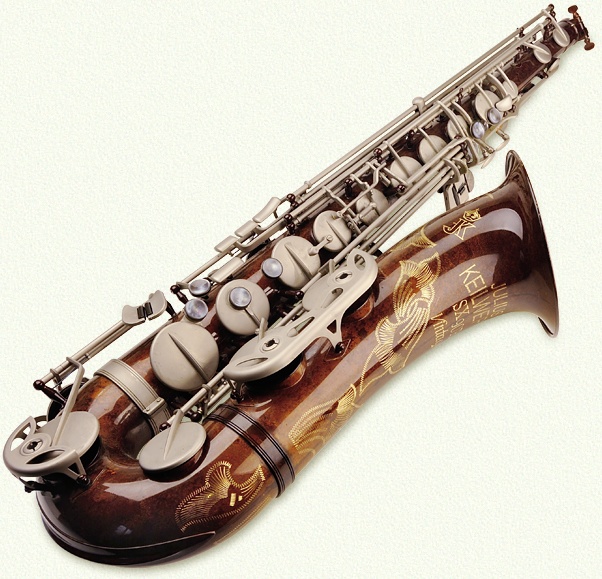 First
up - isn't this a beauty? First
up - isn't this a beauty?
It's Keilwerth's 'Vintage' finish, which takes the currently-poplar
fad for chemically tarnished brass and turns it into a more practical
proposition by slapping a coat of clear lacquer over it - the upshot
being that the horn won't go green and will always look like this...at
least until the lacquer wears off. And the brushed nickel keys provide
a nice contrast to the rich hues of the body. I like it a very lot.
Anyway, this here horn sports a low range 129xxx serial number
- which I estimate to mean a build date of around 2015...give or
take a year maybe - which makes it the most recent example I've
seen to date. Given the improvement in build quality I've seen since
around 2012 I should have had quite high hopes for this tenor.
Have they built upon the improvements noted on the 126xxx models?
Have they at least maintained them? Or is it just business as usual?
However, the client who brought it in complained of some difficulty
and unreliability on the low notes. On most horns this could be
down to leaky pads or poor regulation almost anywhere on the horn
- but on the SX90R it tends to be symptomatic of tonehole warps...especially
when it's a problem that seems to creep up on the player after a
year or so.
 Here's
the low B tonehole - and I'm rather afraid that it completely fails
the flat standard test in quite a big way. Here's
the low B tonehole - and I'm rather afraid that it completely fails
the flat standard test in quite a big way.
As you can see there are a couple of rather large warps either side
of a high spot just left of centre - and the pattern more or less
repeats around the rear of the tonehole. It's not good.
The low Bb was similarly affected, though to a lesser degree.
Wishing to give the horn the benefit of the doubt I'd say that
the low B/Bb toneholes in isolation could have been subject to a
bit of a knock - given how vulnerable they are. However, such a
knock usually results in quite a distinctive warp pattern that tends
to be focussed around the guard stays. A warp to the opposite side
would not be usual.
 And
here's the low C tonehole - which shows a slightly deeper warp. And
here's the low C tonehole - which shows a slightly deeper warp.
All things considered I'd say that this horn is a bit of a step
back from the previous example, and certainly nowhere near the standard
of the one before that - which passed the flat standard test with
flying colours. It's by no means the worst example I've seen, though
- so I suppose I should be grateful for small mercies.
However, I know that Keilwerth can get it right when they put their
mind to it - which makes it so very frustrating to see the quality
control slipping. It's especially annoying inasmuch as the horn
came in at the same time as a Yanagisawa TWO32...which had the most-level
toneholes I've ever seen on a production horn.
I've quoted the owner for a strip down and level job (it ain't
cheap, and these toneholes aren't the only wobbly ones), but having
the work undertaken depends on whether he decides to hang on to
the horn or not. If it were mine, I'd do it straightaway - it's
a gorgeous-looking horn...and in spite of all the leaks it still
has that characteristic Keilwerth bootiness.
I wished for better, and I'm disappointed. But maybe next time...
Addendum:
Build date - Early: Review date - November 2024
I tend not to bother posting addendums to this review anymore because
I'm sure we're all aware of the tonehole issue by now - but if a
particularly interesting example comes in I think it's worth making
note of it.
In this instance the horn bears a 997xx serial number, which beats
the 106xxx numbered model from 1997 by 7000 and makes it one of
the earliest SX90R horns I've seen.
What's also interesting is that for a horn that's approximately
30 years old it's in exceptional condition. In fact it still sports
the original pads - and there's not a single one on the horn that's
anywhere close to need replacing. You might suppose that this marks
it out as a 'closet queen' - but no, it was purchased from a busy
pro...which perhaps means that the original owner didn't much like
the horn, or struggled to play it.
 A
quick check with the leaklight suggest that the latter might be
the case. A
quick check with the leaklight suggest that the latter might be
the case.
Here are the low Bb (top) and B (lower) toneholes, both showing
very substantial warps. There's also some unevenness on the rims
too, which you can just see on the nearside of the low Bb adjacent
to the guard stay.
 The
low C (top) and D (lower) are similarly poor - with both toneholes
showing warps that measure out at around half a millimetre in depth.
That beats the previous record of .4mm, held by the 115xxx numbered
tenor. The
low C (top) and D (lower) are similarly poor - with both toneholes
showing warps that measure out at around half a millimetre in depth.
That beats the previous record of .4mm, held by the 115xxx numbered
tenor.
The rest of the toneholes are much the same to varying degrees -
and I suppose I ought to cut the horn some slack as it's quite an
old horn. But then that supposes that it's been around the block
a few times - though the overall condition of the horn suggests
otherwise. I certainly couldn't find any evidence of knocks and
bashes - indeed there are barely any marks on this horn at all beyond
a few scratches here and there.
The new owner got the horn for what you'd call an extremely fair
price (and then some), and has elected to have all the toneholes
properly levelled - after which it'll be a very nice horn indeed.
If you own a Keilwerth SX90R
series horn and are concerned or curious as to whether your horn
suffers from warped tone holes, you are invited to bring it along
to the workshop for a free inspection. In the course of the inspection
I shall examine and test the instrument and take photographs as
necessary, whereafter they will be added to the rolling reviews
(good or bad).
There will be no charge for this, and in return for your time I
will carry out a basic setup and lubrication job on your sax free
of charge.
|