Yamaha YTS62 MkI 'purple logo' tenor saxophone (with notes on
the MkII version)
 Origin:
Japan (uk.yamaha.com) Origin:
Japan (uk.yamaha.com)
Guide price: £1300 (used, in good condition)
Weight: 3.39kg
Date of manufacture: 1988 (serial range: 012xxx)
Date reviewed: April 2004 (revised October 2017)
For a long time, Yamaha's pro level horn
- now superseded by the Custom and Z series horns, yet still holding
its own...and quite effortlessly too
For those of you who already own a purple logo tenor,
and are browsing this review by way of seeking affirmation that
your choice of horn is a good one, I can save you a great deal of
time and trouble by simply saying 'Yup'. In fact that one word would
probably suffice for everyone else, but for the sake of thoroughness
I might as well explain how I came to that conclusion.
I'd like to begin by laying my cards on the table.
I consider this horn to be one of the finest tenors ever built.
Note: finest...not best. There'll never be a 'best' saxophone -
because you simply can't make a horn that'll suit everyone - but
there are a number of tangible factors that can come together to
produce an end result that's greater than the sum of the parts.
And this is what happened with the 62.
Some might say I'm biased - but here's the thing, I never owned
a 62 tenor. I owned the 62 alto, but the tenor never really hit
the spot for me - and I much preferred the simpler 23, which I used
for 30 or so years before replacing it with a TJ RAW. This isn't
unusual (for me); I get to work on and play a great many wonderful
horns - and while I'm happy to examine them and declare them to
be very fine instruments, it doesn't necessarily mean I'd want to
own one of them.
With that said, let's whip this horn on the bench
and see exactly what makes this such an auspicious horn.
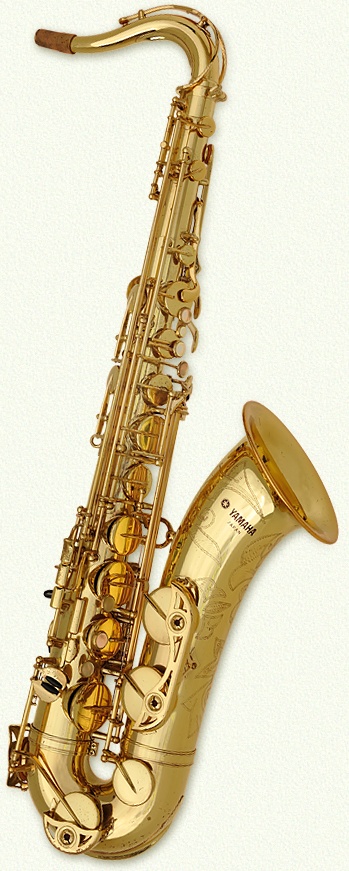
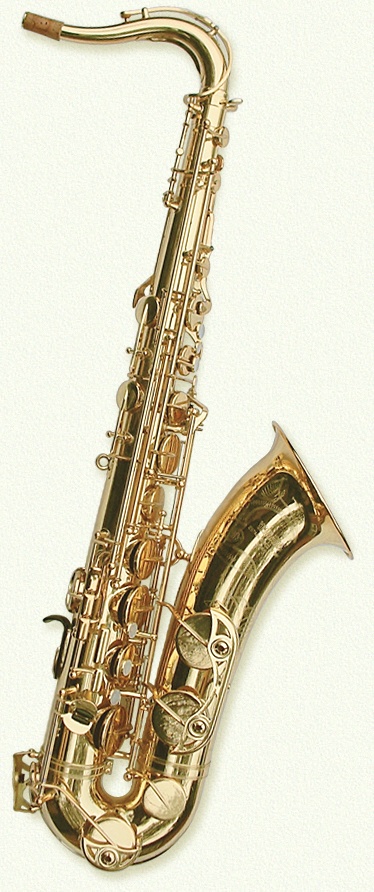
What we have here is a rather tidy Yamaha 62, built around 1988.
Technically-speaking this horn should be known as the MkI - and
it would have been had Yamaha not very slightly tweaked the design
some years later...and then tweaked it rather more and called it
the MkII. This is the sort of behaviour that deeply upsets saxophone
buffs (it's not difficult), but the problem was solved by virtue
of the early MkI being graced with a colloquial nickname - the purple
logo. And with that, order was restored.
At this point I'd like to be able to point at the logo on the bell
- which was just a purple transfer that shows the company logo and
the words Yamaha and Japan - and say "There ya go"...but,
as is often the way, it's long since been rubbed off through handling
down the years. All that's left is a modestly engraved bell with
a blank space where the logo once sat.
The later MkI is easily identifiable by (among other things) virtue
of having the company logo stamped into the bell - but, curiously
enough, this hasn't led to its being called the 'stamped logo'...or
even the Mk1a.
The construction is ribbed, and the few standalone
pillars that remain have reassuringly large bases. There's a two-point
bell brace and a detachable bell, an adjustable plastic thumb hook
and a flat plastic thumb rest. You also get individual guards for
the low C, Eb and B/Bb - complete with bumper felt adjusters. This
feature alone is probably the most visually distinctive against
the all-in-one bell key guard fitted to the earlier 61 series.
 The
toneholes are plain drawn and are generally nice and level. I say
generally because every once in a while I come across an example
with one or two slightly less-than-even toneholes. Nothing dramatic,
mind you, but still worthy of mention. The
toneholes are plain drawn and are generally nice and level. I say
generally because every once in a while I come across an example
with one or two slightly less-than-even toneholes. Nothing dramatic,
mind you, but still worthy of mention.
Another thing that's worthy of mention is the ratio
between the low D key cup and its tonehole. It's a bit on the small
side, which means there's precious little pad overhang. This makes
it quite hard to seat the pad accurately - which means that not
many repairers manage to pull it off...which means that an awful
lot of 62s have leaky Ds.
It's easy enough to check - just arm yourself with a cigarette paper
and head over to my article on Testing
Leaky Pads. All will be revealed. Quite literally.
The bell brace is an unusual design, and on the face
of it I'd consider it to be a bit on the weak side. The mount point
on the body is a bit small, and although the lug that secures the
brace to the body-mounted boss is hefty enough, it relies on just
those two protruding stubs to hold the bell in line against the
inevitable knocks the bell will be subjected to.
And yet it's not often that I see one of these with an offline bell...so
either the owners are being extra careful, or the bell brace is
more than up to the task of holding the bell in place.
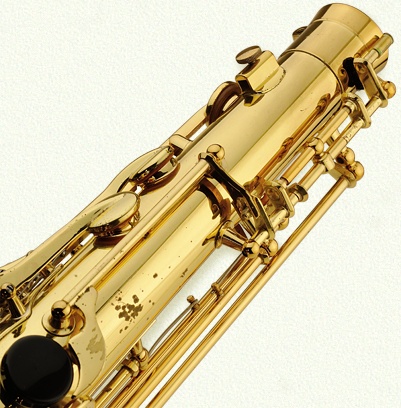
You'll no doubt have already noticed that the lacquer's
a bit worse for wear, but given the age of this horn (almost 30
years old) it's still quite presentable. This is something Yamaha
have always been good at - and if any of the fittings ever pop off,
there's a fair chance that a repairer (with a suitable amount of
skill and a little bit of luck) will be able to resolder the fitting
without burning the lacquer. It's tenacious stuff - but think of
an 'invisible' resoldering job as a bonus rather than an expectation.
 You
might also have noticed that the fittings are rather neatly attached
to the body. This is (or rather was) another of Yamaha's trademarks
- their solderwork used to be excellent. Not too much, not too little,
and good quality solder too. In more recent years that crown has
slipped somewhat - most likely due to a shift towards lead-free
solder. In fact I had to raise both eyebrows when I reviewed the
MkIII alto. You
might also have noticed that the fittings are rather neatly attached
to the body. This is (or rather was) another of Yamaha's trademarks
- their solderwork used to be excellent. Not too much, not too little,
and good quality solder too. In more recent years that crown has
slipped somewhat - most likely due to a shift towards lead-free
solder. In fact I had to raise both eyebrows when I reviewed the
MkIII alto.
On to the keywork, which bristles with modern features
- of which my particular favourite is the provision of regulation
adjusters on both main stacks.
Yamaha certainly weren't the first manufacturers to use stack adjusters,
but they weren't exactly commonplace - and neither of their biggest
rivals (Selmer and Yanagisawa) used them. There's a lot of nerdy
debate about whether or not adjusters are a good idea, but from
a repairer's point of view they make setting up the action a breeze.
When people ask me what it takes to regulate a horn I tell them
that you first set the horn up 'by the book'...and then you throw
the book away and set the action up by feel and playing. This is
because a horn is actually quite a crude piece of kit; things bend
and flex, the mechanism really isn't that precise and you're having
to deal with an organic component (the pads) - so it's inevitable
that some compromises are going to have to be made. Regulation adjusters
allow you to dial in the required amount of compensation with ease
- and if you go too far you don't have to faff about with replacing
over-sanded corks...you just tweak an adjuster and you're back to
where you started from, ready for another go.
And as well as the regulation adjusters you also get the usual adjusters
for the G#/BisBb and low C# to B link.
Note the springs. These are stainless springs. If
you have one of these horns and you're considering changing the
springs for blued steel ones, take my advice and leave them well
alone. This horn was designed to use this type of spring, and when
they're tweaked by someone who knows what they're doing the resulting
feel to the action is superb. Better still, the springs will last
almost indefinitely.
Yamaha retained the stainless springs right through the MKI series
(which is another way to spot them), but switched to blued steel
springs on the MKII. I don't really know why they did this but I
suspect that they fell prey to the popular notion that pro horns
should have blued steel spring fitted.
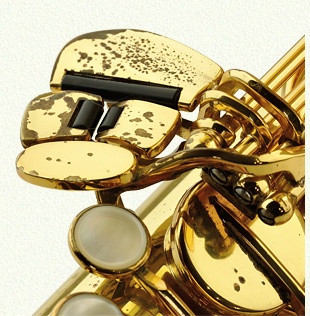 The
bell key table was revised between the purple and stamped logo models. The
bell key table was revised between the purple and stamped logo models.
The purple logo had a non-tilting table (left) - which means that
there was no connection between the low Bb and C# touchpieces, so
they moved independently of each other.
There are pros and cons to this design (as always). On the pro side
it makes for a lighter, more responsive table - and the relative
simplicity of the layout means the table is less prone to damage
from the odd knock. It also makes for a quieter action.
On the con side it makes going between low Bb and C# a bit more
of a chore, and the tilting Bb touchpiece can get rather rattley
if you don't keep on top of the lubrication.
There's no out-and-out winner, but I've always liked the way a well-designed
non-tilting table feels under the fingers.
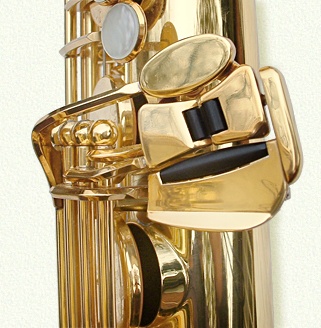 On
the lower right is the stamped logo bell key table, and as you can
see it's been considerably redesigned with larger spatulas and a
shaped roller on the Bb touchpiece. On
the lower right is the stamped logo bell key table, and as you can
see it's been considerably redesigned with larger spatulas and a
shaped roller on the Bb touchpiece.
I have some misgivings about the compound pillar on which the bell
keys are mounted, as it's a single pillar with multiple heads and
the base is a bit on the mean side. But, like the bell brace, it
doesn't seem to have presented any significant problems down the
years...so don't worry about it.
A quick word about the key pearls, which, incidentally,
are all concave...including the Bis Bb. On the purple logo model
they were proper mother-of-pearl - but were later changed to plastic
ones on the stamped logo model. I'm not too sure exactly when the
change took place but this example dates from 2001, which makes
it among the last of the Mk1s ever built
One thing's for sure, though - it was all about saving money on
the production costs...and this rather hints at why the purple logo
Yamahas are now becoming rather sought-after horns. I guess it's
reasonable to assume that if they went to the trouble of swapping
out the real pearls for plastic ones to make what must have been
a very small saving, they quite probably found a few rather less
obvious ways to cut production costs.
As with many things these days it's a case of 'first make it good,
then make it cheaper'.
Proper point screws are used throughout, which bodes
well for long-term reliability. The screws are fitted with nylon
collars which serve to lock them securely in place. There's also
some scope for adjustment built in to the screws, which means you
need only give them a bit of a tighten up to take up any free play
in the keys. This is a very nice feature that'll save you a few
quid down the years, because it means your repairer won't have to
faff around with reaming out the pillars - at least until such times
as the actions wears beyond the amount of built-in travel. And then
you ream the pillars as normal, which restores the tightness of
the action and the scope for further adjustability.
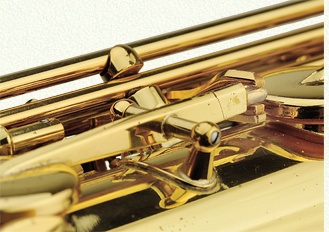 Another
excellent keywork feature is the use of simple fork and pin connectors
for the side Bb and C keys. Another
excellent keywork feature is the use of simple fork and pin connectors
for the side Bb and C keys.
This was a huge improvement over the dreadfully fiddly pin and barrel
connectors that were fitted to the earlier 61
series.
Complicated side key connectors are always more trouble than they're
worth and they're nowhere near as slick and quiet in operation nor
as robust as plain old forks and pins - which is why it's always
been a mystery to me as to why Yamaha reverted to barrel-type connectors
on their Custom models.
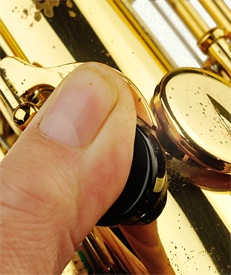
While we're poking around the side keys there's something
of a potential issue surrounding the proximity of the side C key
cup with the octave key touchpiece.
Whether this'll present a problem depends on a couple of conditions.
There's very little clearance between the outer edge of the thumb
key and the adjacent edge of the key cup. If the buffer cork beneath
the touchpiece wears or falls off, it'll allow the thumb key to
drop further and possibly collide with the key cup.
 Alternatively
the key cup may not be set at dead centre to the tone hole - and
if it's shifted to the left a little it may foul the octave touchpiece.
You'll certainly know about it when it happens - you'll either get
an annoying click every time you press the octave key - or you'll
lose everything from top B down, as the octave touchpiece pushes
the side C key cup open. Alternatively
the key cup may not be set at dead centre to the tone hole - and
if it's shifted to the left a little it may foul the octave touchpiece.
You'll certainly know about it when it happens - you'll either get
an annoying click every time you press the octave key - or you'll
lose everything from top B down, as the octave touchpiece pushes
the side C key cup open.
 It
might seem like an odd thing to point out, but I've come across
it on a few 62s - and it would appear that someone at Yamaha recognised
the potential for this to happen and incorporated a discreet chamfer
beneath the tip of the octave key touchpiece to help lessen the
chance of a collision. It
might seem like an odd thing to point out, but I've come across
it on a few 62s - and it would appear that someone at Yamaha recognised
the potential for this to happen and incorporated a discreet chamfer
beneath the tip of the octave key touchpiece to help lessen the
chance of a collision.
It's no big deal though, and simple enough to fix if it ever turns
out to be a problem on your horn.
And that just about wraps it up for the keywork, other
than to say you get an excellent swivelling octave key mech, a very
large and comfortable teardrop-shaped front top F key and a decent
set of pads that are fitted with nylon reflectors.
The whole outfit came in a very nice box-type case, with a couple
of proper catches and plenty of storage space for your bits and
bobs. As far as cases go it's a bit on the bulky side, and I've
always felt that the outer lip of the bell is a tad too close to
the top side of the case (so don't sit on the case) - but other
than that it's well built and should last a good few years.
Under the fingers the action feels very comfortable.
These days that probably sounds like damning with faint praise -
but when these horns first hit the market, the quality of the action
was practically revolutionary. I've often heard it said that even
if you don't like how the Yamaha plays, you have to admit that the
action's superb. And so it is, or rather it has the potential to
be.
Out of the factory the action tends to be set rather heavy, and
a little on the high side. It's fine, but with a few tweaks it can
be truly wonderful.
With that said it's wise not to overdo it. I see quite a few 62s
that have been, shall we say, 'enthusiastically' tweaked - with
the result that the keywork's practically flapping about in the
breeze and the pads are so close to the toneholes that the poor
old horn simply doesn't have room to breathe.
Tweak it carefully and sensibly and it'll pay huge dividends.
 As
for playability, well, it rocks! As
for playability, well, it rocks!
The 62 has bags of power and projection, but no matter how hard
you push it there's never a sense that the tone is getting away
from you. It has a remarkable combination of thrust and control
that allows you to play by the seat of your pants and never quite
fall off the chair. And it's drop-dead easy to blow.
And what's the sound like? Well, it's like anything
you want it to be.
Tonewise the 62 starts out warmer than its cheaper brethren, and
if you want to accentuate that warmth or pull more cut and brightness
from the horn it'll simply follow you. Responsiveness comes built
in at the factory. The low notes are gorgeously crisp on this horn,
and yet retain all the warmth you need if you fancy a spot of subtone
smooching. Similarly the top notes are nicely refined, with less
of the tendency to shout that the cheaper models have.
The evenness of tone is remarkable, with only the mid D requiring
a little extra forethought (a tricky note on any sax anyway). With
that said, it's perhaps this evenness that marks out the line between
those who love the Yamaha and those who feel it lacks character.
It's essentially the classic payoff scenario - give with one hand,
take with the other.
 Up
until the arrival of the 61/62 the standard approach to building
a horn was to focus on the tone. This is fine, but it tends to mean
that compromises have to be made in other areas, such as the tuning
and the way in which the tone changes as you go up or down the scale.
It sounds terrible, but it's a recipe that worked very well for
many horns...including the venerable Selmer MkVI. Yamaha took a
different approach and focussed on producing a horn with a much
more stable and cohesive soundstage. This gave the 62 a sense of
neutrality; it didn't stamp an in-house sound all over your playing
- it just gave you the notes and let the player decide where to
steer them tonally. Up
until the arrival of the 61/62 the standard approach to building
a horn was to focus on the tone. This is fine, but it tends to mean
that compromises have to be made in other areas, such as the tuning
and the way in which the tone changes as you go up or down the scale.
It sounds terrible, but it's a recipe that worked very well for
many horns...including the venerable Selmer MkVI. Yamaha took a
different approach and focussed on producing a horn with a much
more stable and cohesive soundstage. This gave the 62 a sense of
neutrality; it didn't stamp an in-house sound all over your playing
- it just gave you the notes and let the player decide where to
steer them tonally.
Both approaches have their pros and cons - it just means that the
player has to tailor their blowing to suit the horn. Depending on
the desired end result, some players will find one approach easier
than the other. T'was ever thus.
Of course, a lot has changed in the years since the
62 made its debut - and in recent years it seems to me that some
manufacturers have been working hard to refine the tonal/tuning
compromises yet further in an effort to re-inject some of the tonal
colour that got washed out of saxes in the last few decades. But
the 62 (now in its third iteration) remains a hugely popular horn...so
they must have got something right.
With that said, there are quite a few players (myself included)
who feel that the modern 62 has lost some of its original charm.
The later MkI (seen here on the right) is essentially the same horn
as the purple logo, but both the MkII and the MkIII stepped further
and further away from the spirit of the original horn. Don't get
me wrong, they still have that '62 thang'...they just don't seem
to have quite so much of it.
But here's a canny tip. If you have one of the newer models - beg,
borrow or steal a crook from a MkI 62 and see whether you feel it
makes a difference. I think you'll be surprised...
But I said this was one of the finest tenors ever
made - and I guess I ought to justify that claim.
The design and build quality has a great deal to do
with it. It set the standard in its day - there's absolutely no
doubt about that - and it remains a credible benchmark today. It
was also a very consistent horn, so-much-so that you'd never have
to worry about losing your horn and being unable to find a replacement
just like it. Sure, there were differences between individual horns
- there always will be, that's the nature of horns - but they were
nowhere near the level of inconsistencies you could experience when
trying out a bunch of Selmer MkVIs.
The action was formidable. Even when indifferently
set up it ran like a train - and it stayed that way even if you
stretched your service intervals.
And then there's the tonal approach. Even if it's not your cup of
tea it cannot be denied that it marked a shift in the way in which
horns were presented. It lightened the load on the player, it took
away some of the need to steer the tone and the tuning while desperately
trying to manage the tonal transition between one note and the next.
It also set a new standard for mass-produced horns, and in so doing
threw down the gauntlet to other manufacturers. Some of them picked
it up, some of them didn't.
And it did all this at a price that made it an affordable proposition
for players who were fed up with vintage bangers or who simply couldn't
fork out the cash for a Selmer.
That's no mean feat - and that's why I have a great deal of respect
for this horn.
So, in summing up - the purple logo is now officially
a classic pro horn that ought to be on any prospective buyer's shopping
list - and despite its newer, flashier competitors from the same
factory (and others) it's still a horn that makes me go 'Yup!'.
Notes on the MKII YTS62 (April 05):
It's hard to spot any differences in the latest version
of the 62. There are some changes to the bell key spatulas and the
octave key mechanism, and the horn features a beefier crook socket.
Probably the biggest change is the inclusion of the new crook (in
this case the G1 model). I didn't notice any particular change in
the way the horn felt under the fingers, but then neither did I
notice anything undue worth commenting on - so perhaps the changes
to the keywork will be noticed more by some than others.
Much is made of the annealing process that the brass is subjected
to during the horn's manufacture, but I suspect that the redesigned
crook makes more of an impact to the tone. Annealing is a process
involving heat, which reduces the stresses and strains that build
up in the metal as it's worked. One way to put those stresses back
in is to hit the metal...a process known as work hardening. Every
time you press a key down you'll impart a small shock to the body
of the horn and over time this will result in work hardening. In
other words you'll be back where you started from. It's a nice selling
point, but I wouldn't place too much relevance by it.
The tone is slightly different though. It's less pushy than the
MKI, more laid back - but with extra smoothness in the upper register.
For dyed-in-the-wool Yamaha fans (like me), it's perhaps a bit of
a shame...I've always loved the exuberance and fireworks of the
older models - but for newcomers and fans of warmer horns these
changes should prove to be quite appealing.
I'd be quite happy with a MkII, though I'd want to put back that
classic Yamaha bite by using the old crook.
The case supplied is of the semi-soft variety, quite
sturdy yet light. Certainly good enough for gigging around with
- and the fitted shoulder strap is a useful addition.
Guidelines
for ebayers and other auctioneers
|