Keilwerth SX90 straight alto saxophone
 Origin:
Germany Origin:
Germany
Guide price: £1200 (used)
Weight: -
Date of manufacture: Mid 1980's
Date reviewed: November 2006
An unusual and flamboyant professional quality
alto sax
Now would you just look at this...isn't it amazing?
I think I'm probably luckier than most players in that in my role
as a restorer of period instruments I've been privileged enough
to work on some truly spectacular and unusual instruments, and I've
often felt that the world lost something wonderful with the passing
of the perfect marriage between engineering and artistry that blossomed
in the Victorian era.
But looking at this instrument rekindles that sense of wonder -
it's industrial art of the highest order.
Is it art for art's sake though...?
This being a Keilwerth horn my first port of call on my workbench
inspection was the tone holes. Fortunately this is a plain SX90,
and not the SX90R with the notorious soldered-on tone hole rings,
and I was delighted, nay relieved, to see nice, neat, plain, level
tone holes. And so they should be.
(I noted that the tone hole rims weren't plated, which indicates
they've been levelled after the finishing process).
In a similar fashion the body is likewise nice and neat - though
by no means plain.
I've always felt the Keilwerths have a sort of art-deco industrial
look about them, and it's a look that works extremely well - in
particular the angular pillars, which are both well made and fitted
and beautifully combine style with function.
The guards and other fittings are equally good, and blend in nicely
(I have my doubts about the bell key guard, shown later) - although
the large thumb hook looks a little out of proportion on this straight
alto...perhaps due to the lack of body curves?
The body material is brass - and the engraving on the bell section
stands out beautifully against the plating.
The finish is black anodised nickel - and looks absolutely superb.
Fancy finishes have been around for a while now (indeed, since
the 1920's, if you count matt silver and gold washes as a fancy
finish) and for the larger part have been confined to coloured lacquers.
These can look great, initially, but once the finish gets scratched
or starts to wear it makes the horn look shabbier than a standard
gold or clear lacquer finish. Specialised plated finishes arrived
on the scene next, black nickel seems to be about the most popular.
These finishes have the advantage of being considerably tougher
than lacquer, but they're still subject to wear and tear - and the
contrast between the body metal colour and that of the finish can
still make the horn look shabby.
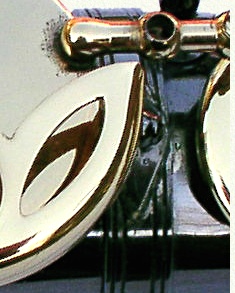 In
this horn's case the underlying metal is yellow - quite a contrast
to the black sheen of the plating, and should the horn ever require
any major bodywork or soldering you're likely to lose some of the
finish. In
this horn's case the underlying metal is yellow - quite a contrast
to the black sheen of the plating, and should the horn ever require
any major bodywork or soldering you're likely to lose some of the
finish.
Unlike lacquer though, touching up the finish isn't a practical
proposition - so you'll have to make the decision as to whether
to forego the inevitable cleaning up that such work requires in
order to preserve as much of the plating as possible.
That's what's happened here, where someone has done a (slightly
messy) soldering job on one of the bell key guard stays.
I'd imagine that, with a little care and patience, you could touch
up small cosmetic defects like this with some appropriately coloured
nail varnish...or even a spirit-based marker or felt-tip pen.
From the crook socket to the first bell joint the horn is as per
the standard SX90 alto - thereafter the design is obviously radically
different. Or is it?
In terms of the bodywork all that's needed to make a straight alto
is straight tube to connect the standard body to the standard bell
- there would be no need to redesign anything but the bottom bow,
and not only does this make solid engineering sense it also makes
sound economic sense too.
The keywork is just as well built as the body. Keilwerth have a
very 'individual' approach to their keys, and this shows in various
places.
There's the unusual key pearls, which sit atop the touchpieces rather
than in them. I feel it makes the keys look a bit bulky, and raises
the finger height very slightly - though you may well find them
quite comfortable in use.
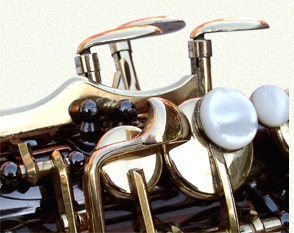 There's
also the adjustable palm key touchpieces which, despite looking
a little too industrial, work quite well - though inveterate tweakers
might find themselves forever fiddling with them in an attempt to
find the ideal setup, considering that both height and horizontal
angle is adjustable. There's
also the adjustable palm key touchpieces which, despite looking
a little too industrial, work quite well - though inveterate tweakers
might find themselves forever fiddling with them in an attempt to
find the ideal setup, considering that both height and horizontal
angle is adjustable.
You also have the anti-stick G# mechanism - which although not the
most elegant solution I've seen seems to work reasonably well after
a fashion, if a little clunky and hesitant sometimes.
Top marks go to the front top F key touchpiece which is a sheer
joy to use, and to the bell key spatula arrangement which is slick
and comfortable in use. I'm also pleased to see the use of simple
forks and pins in the side trill keys, which makes for a fast and
responsive feel to these keys.
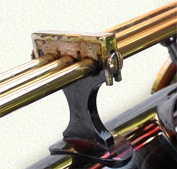 The
straight body calls for a few changes to the keywork below low D,
the most notable of which are to the bell keys. The design necessitates
very lengthy key barrels for the low C#, B and Bb - and I was very
relieved to see that the potential for key whip (where the barrels
flex when the keys are operated) has been duly noted and addressed
by means of a rather sturdy guide just above the low C tone hole.
The guide, which is adjustable, features a clamp which contains
a buffering material which allow the key barrels to rotate freely
and quietly yet prevents them deforming. An essential addition,
though I think more could have been made of the design of the clamp,
it's rather plain and the edges are a tad sharp. The
straight body calls for a few changes to the keywork below low D,
the most notable of which are to the bell keys. The design necessitates
very lengthy key barrels for the low C#, B and Bb - and I was very
relieved to see that the potential for key whip (where the barrels
flex when the keys are operated) has been duly noted and addressed
by means of a rather sturdy guide just above the low C tone hole.
The guide, which is adjustable, features a clamp which contains
a buffering material which allow the key barrels to rotate freely
and quietly yet prevents them deforming. An essential addition,
though I think more could have been made of the design of the clamp,
it's rather plain and the edges are a tad sharp.
I was rather puzzled by this adjuster bar on the low C#, which
has two holes in spite of only needing one. Clearly this is a part
off another horn (a G#/Bb adjuster bar). Given that Keilwerth would
have had to have made at least a few custom keys for this horn,
is it really too much to expect that they could have run to one
purposely built adjuster? I seem to recall seeing this bar fitted
to the F key on some Keilwerth horns...?
While we're here, I'm not sure too that the bell key guard fits
with the overall look of the horn. I'm not sure why, but I have
the feeling that it should be slightly different to the bog-standard
guard used on the standard horns...seems to me it interrupts the
line of the horn. Strictly a personal impression though, feel free
to disagree.
 Proper
points screws and blued steel springs complete the action. Proper
points screws and blued steel springs complete the action.
In terms of feel the action is much the same as the standard SX90
- it's quite precise, though not quite as snappy as that found on
Japanese horns, and doesn't quite have the deftness of an old Selmer...but
it's good nonetheless, and a few weeks of getting used to its nuances
will soon iron out any small niggles.
I did notice a very different feel to the low C and bell keys. This
isn't surprising, as the C key arm is very much shorter than on
a standard alto, and it makes the key feel much more immediate.
Catches you out for a while. Some players may feel that it's quite
a reach for the low C key spatula though.
The low B and Bb meanwhile feel a little heavier, and because of
the amount of metal involved they can't be set quite as light as
on a standard horn before they feel somewhat floppy. There's not
much in it though, but certainly enough to bear comment at this
price point.
I felt that the horn felt a little cumbersome. It ought not to,
in theory - all the key touchpieces are where they are on a standard
horn, but the overall balance felt quite poor, and I couldn't find
a playing position where I was truly comfortable. I suspect though
that this is something you'd get used to after a while, and I certainly
couldn't find any keywork issues which I'd consider insurmountable.
You'd expect that such an expensive and outrageously flamboyant
instrument would have quite a fabulous case to accompany it - and
if you did, you'd be completely wrong. I mean, c'mon guys, the horn
cost thousands of pounds when it was new - it ought to have had...no,
it deserved, a properly made and appointed case. As it is what you
get is wafer-thin ply encased in even thinner aluminium. This isn't
so bad, if a little tacky - it's the innards that beggar belief,
being nothing more than crudely shaped lumps of foam covered in
velvety fabric. I wouldn't mind, but the fabric isn't even stitched
on, it's just glued - and not very well at that. The case as reviewed
isn't all that old, and yet some of the padding has already come
away from the body of the case.
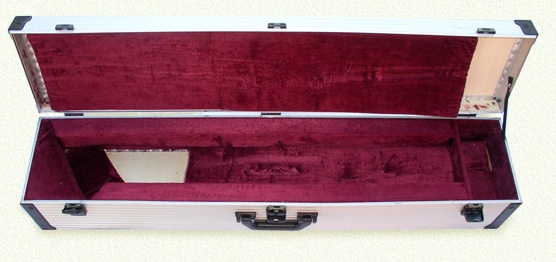 For sure, the exterior of the case is sturdy enough - but it's a
fat lot of good if the innards are inadequate and poorly fitted.
The one concession to accessory storage is a simple boxed off section
at one end, in which the crook, mouthpiece and all your other gubbins
are free to rattle around in. They won't be the only things that
rattle around in the case - with no profiled support the upper end
of the horn simply rolls around as the case is hefted about. It's
honestly the worst case I've seen in a very, very long time - and
from an aesthetic point of view you'd hardly call it attractive.
Another problem relating to care of the horn is finding a stand
for it. They do exist - but expect to have to hunt for them, and
pay a premium for them.
For sure, the exterior of the case is sturdy enough - but it's a
fat lot of good if the innards are inadequate and poorly fitted.
The one concession to accessory storage is a simple boxed off section
at one end, in which the crook, mouthpiece and all your other gubbins
are free to rattle around in. They won't be the only things that
rattle around in the case - with no profiled support the upper end
of the horn simply rolls around as the case is hefted about. It's
honestly the worst case I've seen in a very, very long time - and
from an aesthetic point of view you'd hardly call it attractive.
Another problem relating to care of the horn is finding a stand
for it. They do exist - but expect to have to hunt for them, and
pay a premium for them.
Playing the horn is a very odd experience indeed.
The playing position isn't all that different from a standard alto,
though the design of the horn means the balance feels a little off.
I felt the horn seemed to push back against my right thumb. No big
deal really.
Rather more important was the problem of my right knee knocking
against the bell. This obviously isn't a problem for the standard
alto - nor the tenor or bari, which you tend to throw down one side
- but his horn really only feels comfortable if it hangs straight
down...perhaps a little to the right. If you find yourself getting
all 'inspirational' in the course of a solo and take a step forward,
your knee is liable to hit the bell - and that pushes the crook
into your mouth, with some force too. Believe me, it hurts.
I often hear people saying that curved sopranos sound different
to straight ones - and this is put down to some mystical function
in the bore....but it's really far more likely to be down to the
simple matter of the bell being in a different position relative
to the player's ear. It's the same with this horn, only the effects
are rather more dramatic.
For a start, the bell is over three feet away from your ear as you
play the horn, and faces outward and away.
Under the circumstances, what can I say about the tone?
Although my personal analysis of a review horn's tone isn't an
exact science, it should give the reader a very general idea as
to what they might expect to hear. So, for example, if you were
looking for a seriously warm sound you'd know from reading the review
of the Yamaha YAS275 that you'd probably have to work the horn quite
hard to get such a tone. It's by no means impossible, there are
just other horns that will do the job with less fuss.
So how do I comment on a tone I can't really hear?
From the player's perspective the sound seems quite muted, and
rather distant. I felt like there was a wall between me and the
horn...almost like the sound was coming from another room. I was
assured by a listener that the horn sounded as normal as any other
alto, but then we don't buy horns for how other people hear them
(do we?).
What I missed most of all was the characteristic 'cut' of the alto
- I found myself constantly pushing and pushing to get that little
ringing in the ears which signals an alto is on form and singing.
It just wasn't there - or rather if it was, I couldn't hear it.
I can see how this would be a very severe drawback in an ensemble
situation.
Things improved a little if I played into a corner - the reflected
sound gave me a bit more feel for what was going on - and I'd say
that the tone was quite rounded overall, though I didn't feel that
it was all that full (in, say, the way a vintage Conn or Martin
would be). Similarly there wasn't that much cut or brightness to
the tone.
I'm probably going to get emails complaining about this, but I felt
the horn was simply 'fair to middling' in terms of tone...nothing
particularly outstanding either way, good or bad. Granted, a lot
of this will be down to not having the usual feedback - but even
so, I didn't get the sense that this was a horn you'd buy for its
tone.
All in all I felt very conscious of the horn, and I don't believe
that's a good thing. A good horn ought to be transparent, it ought
to disappear under your fingers and in your hands. I've no doubt
you could become accustomed to this, and there's no reason why you
couldn't play one of these horns as well as any other alto - but
why bother?
I'm going to lay my cards straight on the table - I feel it's a
poseur's horn...it doesn't have any advantages at all over a standard
alto, and quite a few disadvantages. Sure - it looks fantastic,
but what would your expectations be if you saw someone wield one
of these things on a gig? You'd probably expect them to be a very
fine player...and they'd have to be, what with the attention the
horn would propagate, and if they were that fine a player they'd
probably have sussed a long time ago that a horn that feels good
and plays well beats a horn that looks good hands down.
I'll give it top marks for build quality and looks (minus a few
for being cheap with bespoke parts, and minus a lot for the crappy
case), and I can see how appealing it would be to whip one of these
things out on a gig and wow both the punters and the other players,
and the 'fun factor' is undeniable - but I rather feels that's an
appeal that can only go so far...and if I was going to wow anyone
I'd rather it was with my playing than with my kit.
I don't generally post links to other reviews on the grounds that
they're mostly written from the perspective of the player, and often
by people with an interest (be it ownership or marketing) in the
horns - but as this is such an unusual instrument I feel it merits
a second opinion, which you can read here.
|