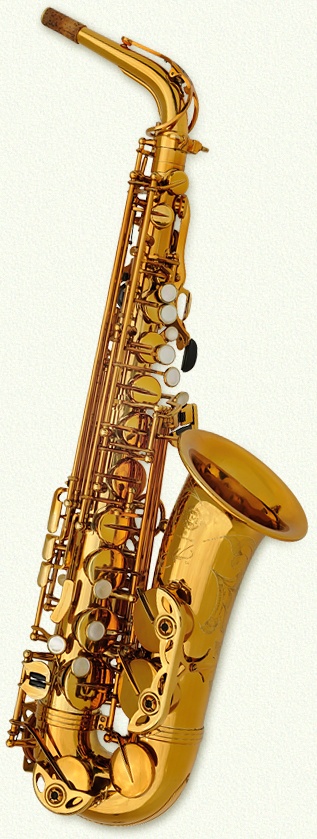
Selmer Reference 54 alto saxophone
 Origin:
France (www.selmer.fr) Origin:
France (www.selmer.fr)
Guide price: £5300
Weight: 2.54kg
Date of manufacture: 2005
Date reviewed: November 2005 (updated May 2020)
Selmer's reincarnation of the legendary MKVI
alto?
* I first published this review in 2005, and decided it was
due for an update. I've added more photos, and gone into more detail
about the construction - but the overall review remains much the
same in terms of build quality. I've also revisited the playtest,
which you'll find at the end of the article.
Gather any group of saxophone players together, give them enough
time (and beer) and sooner or later the topic of discussion will
turn to the ubiquitous Selmer MKVI - and it won't be long before
someone says "If only they still made them".
I suspect that Selmer have thought much the same thing since the
mid 1970's - and so here is their homage to arguably the most famous
saxophone of all time...the Reference 54.
The design philosophy behind this horn was that Selmer took a 'good'
MKVI alto and proceeded to build it anew, hoping to keep the blowing
characteristics it was famed for whilst revamping the action and
the tuning in line with modern standards.
The big question is, have they pulled it off?
Pretty, isn't it?
The most immediate and obvious impression is how dark it looks.
It really is quite a deep gold.
The odd thing is that it's not a uniform finish. Looking closely
at the horn you start to see lighter patches around the key cup
arms and the pillar bases. It's quite a curious effect, and if I
had to suppose how one might achieve such a finish I would say that
it looks for all the world as though someone has lacquered the horn
and then taken a flame gun to it to brown off the lacquer. If it's
intentional then it's quite a remarkable finish - it it's not then
it's probably due to a bad lacquer mixture.
I'm in two minds about whether I like it or not, it smacks a bit
of a sloppy finish that's justified with a "We meant to do
that!".
Looks great from a distance though...and if you don't much like
the finish you can have it in matt for the same price.
It's probably largely academic anyway, the horn is impressively
engraved on the bell but the engraving is cut over the lacquer...and
where there's bare brass there will be tarnish, and where there's
tarnish and lacquer there's soon no lacquer.
Again, they probably meant to do that.
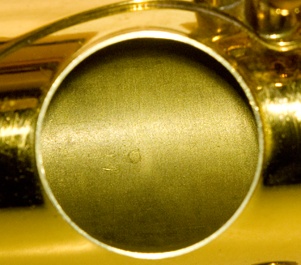 The
construction is pretty much standard fare; ribs are used almost
throughout the horn, and the few remaining pillars that are standalone
have decent-sized bases. As noted in the
Ref.54 tenor review, Selmer appear to have used some sort of
welding system to secure components to the body. The
construction is pretty much standard fare; ribs are used almost
throughout the horn, and the few remaining pillars that are standalone
have decent-sized bases. As noted in the
Ref.54 tenor review, Selmer appear to have used some sort of
welding system to secure components to the body.
In this instance you're looking down through the low E tonehole
to the bore beneath the thumb hook - and right in the middle of
where the thumb hook base sits is a spot weld (more or less dead
centre of the tonehole).
There are lots of these little welds peppered along the bore that
correspond with the position of large fittings - such as the ribs,
bell brace and the thumb hook.
It looks like these components are spot welded in position and then
soft soldered in the usual fashion.
It makes a great deal of sense - at least in terms of preventing
vulnerable parts from dropping off...but it's not such a good idea
if damage to the body requires such a part to be removed in order
to effect a repair. In other words it looks like more of a convenience
for the manufacturer rather than the repairer - and thus you, should
you ever drop the horn.
You get all the mod cons - a triple point bell stay, detachable
bell, adjustable metal thumb rest, large flat plastic thumb rest
and a full set of bumper felt adjusters on the bell key guards.
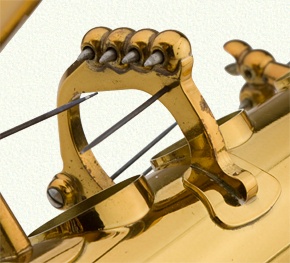
 The
bell stay is slightly different from the original. It's rounded
on one side, flat on the other. At first glance you might suppose
that it smacks of cheapening the design (the original MKVI bell
stay was made from round bar formed into a circle), as someone commented
to me in an email - but it looks sturdy enough and maybe there's
some merit in having a flat surface here (something to do with stress
and tension, no doubt). It's certainly substantial enough to do
the job. The
bell stay is slightly different from the original. It's rounded
on one side, flat on the other. At first glance you might suppose
that it smacks of cheapening the design (the original MKVI bell
stay was made from round bar formed into a circle), as someone commented
to me in an email - but it looks sturdy enough and maybe there's
some merit in having a flat surface here (something to do with stress
and tension, no doubt). It's certainly substantial enough to do
the job.
 Likewise,
the compound bell key pillar is quite beefy. I think I'd like to
have seen a slightly larger base on the nearside foot - but given
that it's a fixed brace (as opposed to a detachable one) I reckon
it ought to be sturdy enough for an alto. Likewise,
the compound bell key pillar is quite beefy. I think I'd like to
have seen a slightly larger base on the nearside foot - but given
that it's a fixed brace (as opposed to a detachable one) I reckon
it ought to be sturdy enough for an alto.
I don't mind admitting that quite a lot of the things I have a
beef about with regard to build quality probably go unnoticed by
the vast majority of players. This isn't necessarily a good thing,
as many of the problems I point up will have a bearing on a horn's
reliability and playability - but when the client actually points
out a fault you can bet your last good solo that it's a pretty serious
problem.
The problem with this horn was a wobbly crook.
Seriously - it actually wobbled, and no amount of tightening up
the crook socket screw would resolve the issue.
This is actually a very significant issue - a loose crook joint
can completely knacker a horn's response, and just about any decent
repairer will be able to tell you stories of how they miraculously
restored the response of a horn that had foxed many lesser technicians
simply by tightening the crook joint.
It's fair enough on a horn that's seen a good few years hard labour
- and on some horns it's a job that might never need doing...but
to have to tighten the crook on a brand new, top-of-the-range horn?
I don't think so somehow.
I think I was even a bit cross about it...so while I'm still miffed
I'd like to point out the weediness of the crook screw, and say
that if manufacturers are going to turn out horns with loose crooks,
could they at least have the foresight to pop on a beefier crook
screw. Pop one on anyway, heaven knows it gets a lot of stick. Thank
you.
Otherwise, the build quality was quite good, with no wobbly tone
holes (hooray!). As a general rule Selmer seem do quite well when
it comes to their toneholes - they're consistently more level than
any other manufacturer. That's not to say they're perfect, mind
you - but I find I have to do a lot less work on them than on other
brands. That said, I'm knocking points off for a dodgy soldering
job on the bell flare joint, just below the low B tone hole. I strongly
suspect (or at least hope) that it's a one-off, but it wasn't very
neat and really should have been picked up in quality control.
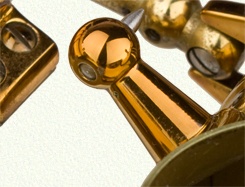 There's
a curious feature in the shape of the low C# lower pillar. There's
a curious feature in the shape of the low C# lower pillar.
What you're looking at here is a point screw. Only it isn't a screw
- it's press-fit into the pillar. I can see why they've gone for
this - the action uses sprung key barrels (see my review of the
Ref.54 tenor for more details) which precludes the need to ream
out the pillars in order to take up any wear and tear. Plus - access
to this particular screw would be impeded by the bottom bow. You
could just about get a standard screwdriver onto the head, but it
would have to be canted at an angle...and that's never a good thing
when you're trying to apply a fair bit of torque.
There are ways around this, of course - but because there'll be
no need to remove this screw it makes sense to make it a permanent
fixture.
The keywork is pretty much as you'd expect on a modern horn, with
all the usual features - and I was pleased to see that they've gone
for simple fork and pin connector for the side Bb and C keys. However,
there are no adjusters on the main stacks - which always gets a
minus on my scoresheet. But Selmer have gone a step further by using
rubber buffers on the lower stack rear bar. Rubber is a fantastically
useful material, with superb properties for all manner of applications
- but one application that it's supremely unsuited to is that of
regulatory buffers.
Two reasons: You can't sand the stuff down to make subtle but crucial
adjustments to the action, and there's give in the stuff. Oh, only
a small amount, but it's plenty enough to make the action feel rather
imprecise. It really shows on the F and E keys. Press either or
both down and you're fine - but press the E down (as in fingering
an F#) then the F and you'll notice the lack of that characteristic
'pop' as the F pad hits home - and when I say 'press' I don't mean
hammer the key home; press it like you'd press it when you're playing.
They tried this stuff on those ubiquitous East German student horns
back in the 70's, and boy did it make the action spongy.
You can make a very significant improvement to the feel of the lower
stack by having your repairer remove these rubber buffer and fit
something more suitable than won't compress. You do get a few adjusters
though - the standard trio on the Bis Bb, G# and low B to C#.
 The
blurb that surrounds this horn makes much of its ergonomic design,
which puzzled me somewhat when I went for a top F using the front
key. It simply wasn't there. My finger rolled up...and...nothing.
No note, no key. Gave me quite a shock! The
blurb that surrounds this horn makes much of its ergonomic design,
which puzzled me somewhat when I went for a top F using the front
key. It simply wasn't there. My finger rolled up...and...nothing.
No note, no key. Gave me quite a shock!
I've noticed that there are three distinct styles of playing the
front top F; some players, like me, will simply roll their forefinger
up to engage the key, others will bend the finger and lean the first
knuckle into the touchpiece, and the rest will physically lift the
finger up and place it on the F key. All methods are viable, though
the latter might be said to be slightly slower than the others.
The point is, the F key should be designed so that any and all methods
work.
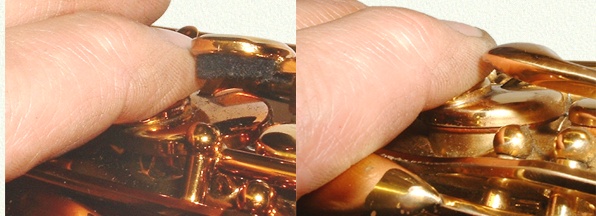
Here are a couple of shots - the first is the Ref 54, the second
is a Yamaha YAS62. Note the position of the F touchpiece in relation
to the forefinger. See how high it is on the Selmer.
This was how it came out of the box. With some bending
and tweaking I made it more of a workable mechanism, but it still
wasn't good enough to work reliably when rolling up the forefinger.
If that's ergonomic then I'm Charlie Parker's aunt.
 I
was also a little concerned about the octave key mechanism. Whilst
there's some merit in hearkening back to a bygone era, I think you
can take the premise a little too far. Although the Selmer octave
key mechanism was a pivotal design (neat pun eh?) it tended to wear
quite rapidly, and subsequent designs by assorted manufacturers
have made subtle improvements. Whilst the mechanism on this horn
bears some improvements I still feel that an opportunity was missed
to address the problem of wear on the central swivel bar (or see-saw,
if you like) - such as the fitment of nylon sleeves, for example. I
was also a little concerned about the octave key mechanism. Whilst
there's some merit in hearkening back to a bygone era, I think you
can take the premise a little too far. Although the Selmer octave
key mechanism was a pivotal design (neat pun eh?) it tended to wear
quite rapidly, and subsequent designs by assorted manufacturers
have made subtle improvements. Whilst the mechanism on this horn
bears some improvements I still feel that an opportunity was missed
to address the problem of wear on the central swivel bar (or see-saw,
if you like) - such as the fitment of nylon sleeves, for example.
Picky, I know, but these horns aren't bought to be stashed in display
cabinets, they're bought to work...long and hard - and a worn, vague
octave key mechanism is not something that's a pleasure to play
with.
Note the distinctly different shade of lacquer on the swivel bar.
It's not a trick of the light - it really is that different.
The action, as factory set, was rather high - and very stiff. It
was simple enough to shim the key feet to knock the key heights
down just a fraction - but it's a great deal harder to get that
classic 'snap' into the action.
The reason for this is the length of the springs (blued steel, incidentally)
on the right hand key stack. If you compare them to those on the
MKVI you'll see that they're about 30% shorter. This has implications
for the feel of the action.
You can demonstrate how this works by taking a wooden ruler and
placing it on a desk, with about six inches protruding over the
edge. Give it a twang (the ruler goes 'boooing'). Now move the ruler
so that only four inches protrudes and give it another twang. It's
a very different feel, isn't it?
This is essentially what's going on with these shorter springs.
You can bend them and tweak them to some degree, but nothing will
replace that extra kick you get from a slightly longer spring.
I was rather disappointed about this - a killer horn should have
a killer action.
 I
note too that a curious sprung rod pivot has been used for the low
C/Eb key. I
note too that a curious sprung rod pivot has been used for the low
C/Eb key.
I've had to 'fix' a few of these since they first appeared on the
market. The design principle is sound enough, two rods separated
by a coiled spring. In theory it means that the tips of the rods
maintain constant contact with the point screws...a self-adjusting
action, no less.
What seems to happen though is that the spring sometimes distorts
and rubs against the key barrel and what you get is a nasty little
grating sound from the key. It's a simple fix, the sprung rod is
removed and tossed away and a solid rod put in its place. Even without
evidence of any grating it's a mod that seems to improve the feel
of these two keys.
If you're interested in how this modification is carried out, check
out my article about it on the Benchlife
Blog.
In spite of all those slightly negative points, the action sits
nicely under the fingers (top F notwithstanding). I didn't notice
anything overly out of place, which is always the benchmark for
a good feel to the action.
The key pearls are proper mother of pearl with a concave profile,
along with a flat oval pearl for the G# touchpiece. Plus points
awarded for the use of a rounded Bis Bb key pearl - but these are
swiftly taken back for the exceptional stickiness of the pads.
I had to take a second look at the pads - I initially thought they
might have been synthetic, so dense was the leather. But no, they're
leather pads, just rather sticky ones. It might be a one-off, or
it might not be, but I had to degrease the pads time and again -
and they were still somewhat sticky when the horn left the workshop.
I'm sure it will ease off in time (and perhaps with enough degreasing),
but it's been a while since I've seen a new horn with pads this
sticky.
There's a choice of case with this horn; a shaped case or a flight
case. This horn came with the shaped case. Nice and stylish, quite
well padded too - but zippered. I really don't like zips on cases
- when they go, the whole case has had it.
A nice touch was a shiny top and a roughened bottom. I get the impression
that this is so that when you sling it over your shoulder the rough
bottom stops the case sliding about. It does too - but if you're
left-handed and throw the case over your other shoulder it kinda
mucks things up.
Time to blow the horn.
I'd heard great things about the Ref 54...lots of great things.
Here and there on the web are dotted comments such as 'the best
alto ever made' and so on, and so when I came to blow the horn I
was more than a little puzzled. Let me explain it thus:
If there was one quality you could assign to the MKVI it was that
it sang, or at least a good one did. It was even more so the case
for the preceding models, the Super Balanced Action and the Balanced
Action. Some may have not liked its rounded tone, others might not
have liked the variable tone across the range, but there was no
doubting its lyrical quality.
This was what I was looking for, hoping for, and didn't find.
What I did find was quite a contemporary sound tonewise, tinged
with a hint of darkness around the edges. Very even right across
the range, with a good balance between free-blowing and resistance
(not everyone likes a too free-blowing a horn, some people like
something to sail against), matched by even tuning right across
the board. I kinda liked it in a way, and it prompted me to heave
out my trusty old Yamaha YAS62 and compare the two side by side.
The Ref. has more body, but lacks the 'cheek' of the 62 - it also
has more roundness, but again lacks the clarity...but there's really
not much in it...and there ought to be. I get the feeling that what
made the MKVI a great horn was precisely its imperfections. Maybe
the price you had to pay for the tone was a little imbalance in
terms of tone and tuning - in the same way that an exciting sports
car sacrifices comfort and safety in return for an exhilarating
ride.
To be sure, it's a good horn; it sounds good, looks good - but
if I were to put it in a line-up against the Yamaha Z alto and the
Yanagisawa 992 I think it would be tough to call it. If I dropped
the Yanagisawa 9937 into the line-up it would make things look distinctly
dodgy for the Ref 54 though - and with Keilwerth hopefully having
resolved the tone hole issue, the SX90R alto more than squares up
to the Selmer.
 I
think this horn gives Selmer a retrospective step back towards the
tonal philosophy of the MKVI, and comes as a welcome and interesting
break from the path the S80 series has followed - but in the time
they've taken to get this model out other manufacturers have been
shipping similar models that hearken back to a more rounded tone...and
it's no longer a one-horse town. I
think this horn gives Selmer a retrospective step back towards the
tonal philosophy of the MKVI, and comes as a welcome and interesting
break from the path the S80 series has followed - but in the time
they've taken to get this model out other manufacturers have been
shipping similar models that hearken back to a more rounded tone...and
it's no longer a one-horse town.
Selmer devotees will probably love it (unless they already own cracking
MKVI's), other players might find it a harder choice.
__________________________
It's 15 years since I wrote much of the above, so
I thought it was high time I revisited my playtest notes to see
if anything had changed. In terms of the build quality the answer
is "Not a lot" - which at least points to some consistency.
But players change over time, so I thought it would be useful to
perform the original comparison - and throw in another contender,
just for fun...
I noticed that my original review made little mention of how the
54 feels under the fingers.
Up against the Yamaha and the RAW it's clear that the shorter springs
in the Selmer show their limitations. Oh, it's not by much - to
be sure - and chances are it's something that I'm more likely to
notice than most players, given that I spend most of my working
days tweaking the action on horns. There's just that little bit
more snap and agility on the 62 and the RAW, but it's by no means
anything approaching a dealbreaker.
The only other significant point of note is that I found the bell
keys on the 54 to be just a little bit lower down than on the other
horns, which caused a few fumbles. Again, not a dealbreaker - and
something it wouldn't take you very long to get used to...unless,
perhaps, you had quite short fingers. I still found the front top
F key to be a pain in the arse.
 As
per the playtest comparison I did back in 2005 I pitched a Ref.54
alto against my old faithful Yamaha purple logo 62...and time I
threw a TJ RAW XS into the ring too. As
per the playtest comparison I did back in 2005 I pitched a Ref.54
alto against my old faithful Yamaha purple logo 62...and time I
threw a TJ RAW XS into the ring too.
There were no surprises between the 54 and the 62 - the observations
I made all those years ago still stand. But the big surprise was
between the 54 and the RAW. Given that (to me, at any rate) the
RAW seems to stand between a Yamaha and a Selmer tonally, I was
expecting it to be quite a close call. But I couldn't have been
more wrong.
Not to beat about the bush - the Ref.54 is closer the Yamaha 62
than it is to the RAW.
The 54 is much cleaner than the RAW. Play the two side-by-side and
the Ref sounds positively refined. Everything's balanced, just 'so'
- there's no fuss, no bother. It's all very...discreet. All very
'cocktails by the pool'.
And then the RAW arrives and drives a Bentley into the pool.
But it's not that the RAW is harsh and uncouth, it's just that
it seems to have so much more inbuilt expression. You have to push
to get it out of the Selmer (and it's there, for sure), but with
the RAW it's just sitting there...gently idling under your fingers.
And it really shows on the low notes. The Ref is assured and confident,
and focused too - but the RAW is like opening a door and stepping
outside. It's way bigger.
I really wasn't expecting this - which led to a hell of a lot of
going backwards and forwards. Slow phrases, fast licks, subtones,
ballads, blues runs, scales and arpeggios - whichever way I tried
it, the results were always the same.
I'm usually pretty confident about the impressions I get from a
horn, but I was so taken aback by the stark differences that I had
to have a peek at my review of the RAW to see what I'd written about
it compared to the 62 and a Selmer BA. And straightaway I saw that
I'd described the RAW as 'weightier' and having a 'full spread'.
That fits.
Now, whether these characteristics are good or bad will depend on
your style of playing - but I think it's very fair to say that the
Selmer's somewhat discreet presentation makes it the better all-rounder,
especially if you're looking to do anything that approaches classical
repertoire. But if you're an out-and-out jazzer the RAW seems to
have more to offer....and if you're into blues and soul I think
it's a done deal.
From my personal perspective I'd say that any of these horns, if
played in isolation, would impress - even if the tone wasn't quite
your thing. They all have obvious quality...and a little something
else that sets them apart from cheaper horn. This is what you'd
expect. What you might not expect is that there's such a price difference
between them.
However, when played head-to-head I'd still take the RAW. But that's
just me, right?
So what's the conclusion? I think it's pretty much the same as
in the original review. The Ref has oodles of precision, but if
that's your bag then I'd recommend trying it against the Yanagisawa
AWO33 - which comes in at around £500 cheaper. And if
you're looking for an alto that's less of an all-rounder and more
of thrill, then there are a number of contenders - of which the
RAW probably heads up the list.
|