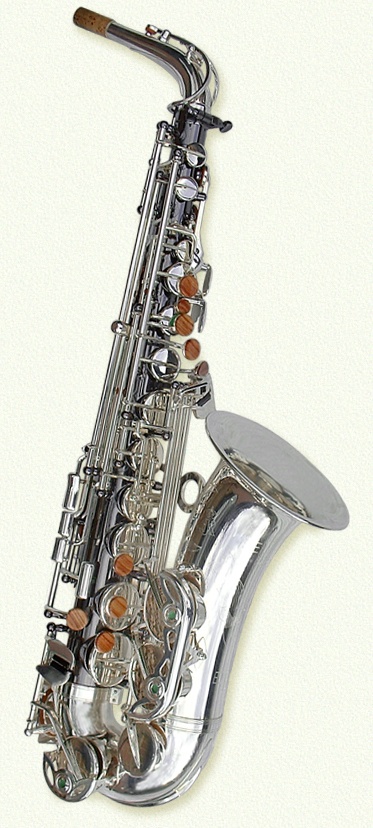
Keilwerth SX90R alto saxophone (Edition 75, or Anniversary)
 Origin:
Germany Origin:
Germany
Guide price: This variant no longer manufactured, current versions
around £3000 new
Weight: -
Date of manufacture: 2000
Date reviewed: February 2005 (Addendums
added, see below)
A professional quality instrument with many
unusual features
Note: This extended
review covers several variants of the SX90R series
At around the turn of the 1970s the saxophone market was dominated
by the 'Big 3' - Selmer, Yamaha and Yanagisawa.
Any other manufacturers active at that time were considered to
be in the background - and perhaps the largest of these were Keilwerth.
They'd been turning saxes out for a number of years, but it wasn't
until they produced the SX series of horns that they finally stepped
into the limelight. Such was their impact that the Big 3 are now
known as the Big 4.
That's quite an achievement - so let's see if they're up to the
competition...
There are two things about this horn that strike you the moment
you clap eyes on it.
The wooden key pearls and the wide bell flare.
These features, particularly the wide bell, give this horn a very
unique and distinctive look. Couple that with a body finished in
anodised black nickel and silver plate, and you have a horn that
really ought to be able to put its money where its mouth is.
It gets off to a good start with the build quality.
There's a definite air of precision about the construction, and
the angular pillars lend the horn a clean-cut image, though perhaps
less so than on the tenors.
I'm inclined to feel that the pillar bases are just a touch on the
small side - though the flipside to that argument is that it's better
to have a pillar pop off in the event of a drop than have it hang
on and stove in the body.
 There's
a very substantial and stylish bell brace fitted, and it's comforting
to see that the body mounts are suitably beefy too. As usual, the
brace is detachable (which is a useful feature for repairers). There's
a very substantial and stylish bell brace fitted, and it's comforting
to see that the body mounts are suitably beefy too. As usual, the
brace is detachable (which is a useful feature for repairers).
The key guards are pretty much standard - though perhaps tad on
the thin side, but well fitted with substantial mounts.
A removable bell completes the body.
The action is as well made as the body and just as well finished.
The gizmo that aids the opening of the G# key cup (see tenor
review for more details) tends to make the horn look a little
untidy though, but at least it works after a fashion. You'll probably
need it too - horn with rimmed or rolled tone holes tend to suffer
somewhat from sticking pads.
A nice touch is the adjustable palm key touchpieces.
I can't say that it's a particularly elegant solution, and I feel
that the touchpiece stems are perhaps a little too weedy (though
I've not yet heard of anyone who's broke one) but it's a system
that works.
 It
should allow you to play about with the height and rotation of the
touchpieces until you're completely happy. It
should allow you to play about with the height and rotation of the
touchpieces until you're completely happy.
Mind you, sometimes you can have too much choice - and I'm pretty
sure that some people will end up adjusting the touchpieces for
ever more in an effort to find the best position for them.
More thought again has gone into the bell key spatulas, and I particularly
like the very sturdy pin and socket arrangement for the low Bb to
C# link. It's simple, neat and reliable - and it just plain works.
It's a big improvement on the standard design used by almost every
other manufacturer, which uses a closed box.
 The
positioning is good too, with all the keys falling nicely under
the fingers. I can't quite say the same for the low C, which I find
a little too far back - but then that's the sort of thing you can
become accustomed to. The
positioning is good too, with all the keys falling nicely under
the fingers. I can't quite say the same for the low C, which I find
a little too far back - but then that's the sort of thing you can
become accustomed to.
The rest of the action is very well laid out. Keilwerth have been
quite daring in places with regard to key design, and whilst it
sometimes looks a little odd it does actually work. The Auto or
front F key, for example - looks very different from the norm, and
feels different too - until you realise just how well it works when
you roll your forefinger knuckle up to activate it. I'm pleased
to see a simple prong and fork arrangement used for the side Bb
and C keys, as opposed to some fancy gubbins that wears badly and
ends up rattling.
The whole lot is powered by blued steel springs, and proper point
screws have been used throughout. A reassuringly large adjustable
thumb hook tops the whole lot off.
So far, so good - but what about the niggles?
Well, I'm not that impressed with the key pearls. Rather than going
for the traditional (and neat) cupped type, these pearls look to
be simply stuck onto a plate atop the key cup. It doesn't look particularly
attractive - and it makes the action feel wider under the fingers.
There's only about 3 or 4 millimetres in it, but in terms of feel
that can be quite significant.
From a strictly personal point of view, aesthetically speaking,
I don't think the wooden pearls work. Maybe if they'd been made
in Ebony they'd look a bit more 'integrated' - but my impression
is that it looks a bit amateurish.
The case is of the semi-soft variety - which is fine enough, and
it's certainly up to the grade, but it closes with a zipper...and
in my experience zips have a nasty habit of breaking. Having said
that, it appears that the case cover is removable - so fitting a
replacement zip might be an option.
But all of this pales into insignificance beyond this point...
If you've read my review of the SX90R
tenor you'll know that there's an issue with the tone holes
on these saxophones.
If you're not familiar with the article then I'd recommend you have
a look at it when you've finished here, and also the accompanying
article on warped tone
holes - but to summarise briefly every SX90R that I've seen
has had at least one warped tone hole.
 This
particular saxophone fared better than most, but still featured
a very significant warp on the low C. This
particular saxophone fared better than most, but still featured
a very significant warp on the low C.
Here's the tone hole, with a ground level die sitting
atop of it. The two red lines on the right indicate the surface
of the die (this would be the leather of the pad) and rim of the
tone hole. Ideally they should meet - as they do in the dead centre
of the tone hole. This would provide the perfect environment for
a decent seal as the pad is brought down over the tone hole.
The two red lines show the maximum gap at the apex of the warp.
Bear in mind that a test for
leaking pads is to slip a cigarette paper between the tone hole
rim and the pad - if the pad seats it will grip the paper. If it
grips only lightly then you have a small leak, but still one large
enough to affect the note. If it grips even less, or perhaps not
at all, then you have a significant leak. Now consider that the
thickness of a cigarette paper is less than that of one of the red
lines. The gap isn't confined to a single point either - it's an
arc, and in this case I would estimate that about one fifth of the
tone hole would leak against a flat pad. Now look to the left of
the tone hole and you can see a similar but smaller gap. It's true
that the flexibility of the pad will take up some of the discrepancy
- but by no means all of it, and only for as long as the pad remains
flexible. Pads harden with age, and they're inclined to move somewhat
depending on how wet or dry they are.
In short, it all adds up to a problem with reliability in the long
term.
The horn is a lively player, plenty of cut and precision.
Given the wide bell rim and the slightly retro look I was half expecting
it to err on the warm side tone-wise, but it's actually quite a
bright horn.
It gets a tad too bright on the top C - I noticed this note jumping
out on me in fast passages.
I'd put the tone as being 'middling' - which would make it quite
a versatile horn with an appropriate choice of mouthpiece.
The tuning is spot on, I noticed no problems at all.
I began to notice the feel of the thick pearls under
my fingers. Rather than sitting more or less on the pearls, their
height forced my fingers to rest on the front edge. It got uncomfortable
after a while, and I'm none too sure that this is something that
an experienced player would get used to. It's not an insurmountable
problem - just replace the pearls with something thinner...or simply
have them filed down a little. You could even file them at an angle...
Similarly, I found myself tripping up around the low C/Eb keys -
but again that's likely to be a problem only for an experienced
player who's used to a different horn.
The tone hole problem made itself known. The low notes
on this horn are very good...not overly fat, but crisp and precise
- but in order to get the full range of tone and expression out
of them you really do have to power down the keys. I've seen this
time and again with this model - clients will happily show me that
they can blow right down to the bottom end, and they will...but
it's at the expense of finger pressure.
After 30 odd years of playing, my fingers are pretty much 'set'
at a standard pressure when I pick a horn up. I know what to expect,
and if I don't get it then it's usually the first sign of a leak.
If you place this horn next to any other similarly specified horn
and then play the low notes with the absolute minimum of finger
pressure you'll see precisely what the problem is. This is essentially
how a horn should work: your fingers should need only sufficient
power to overcome the spring tension...plus a little bit extra for
good luck. Any more than that is completely unnecessary - and it
gets tiring eventually.
The Keilwerth will give you about 80% of the low note tone with
a light touch - but when you force the pads home against the warped
tone hole you get the full 100%...and it's nice...but you really
shouldn't have to work for it at this price level.
I expect this review will generate about the same
level of ill-feeling as the tenor one did - my mailbox played host
to a number of emails from disgruntled SX90R owners.
Such grumbles are sadly misdirected though. All you see here is
what I see when a horn hits the workbench. I agree that it's possible
to debate the comments on tone and suchlike, but that'll always
be the case - and they're presented strictly as personal impressions
and a rough guide as to what you might reasonably expect a horn
to do. What's not open to debate is the physical structure of a
horn - what you see is what you get, and if you have any misgivings
about it you should be talking to the manufacturer.
In effect that's what these reviews do (at least in terms of instruments
still in production) - they serve as a consumer guide, and maybe,
just maybe, manufacturers will think twice before saying "Aw,
that'll do" before turning out instruments with mechanical
defects.
The fact of the matter though is that the SX90R is
a good horn - but it's tragically let down by the tone hole problem.
And it really is a tragedy. Given the build quality, the unusual
but effective keywork, the impressive finishes available and the
tonal versatility of these horns I feel it has the potential to
be horn that could easily cope with a huge range of styles - from
hard R 'n B to frenetic Be-Bop...right through to out and out classical
- but until the tone holes are sorted out I simply can't recommend
this horn. The plain SX90 should be a better bet - same horn, but
without the tone hole rings.
Addendum
04/11/05:
I am cautiously delighted to announce the very first
SX90R series horn I've seen that has level tone holes (serial number
119xxx). I say cautiously because I sincerely hope that it marks
an end to the disgraceful build quality issues I've seen in the
previous models I've reviewed, and yet I feel entirely justified
in wondering whether this particular example was an anomaly. Only
time will tell, but for the present I'm pleased to be able to make
good on my promise to announce to the world in general that I have
seen an SX90R series horn that meets my expectations.
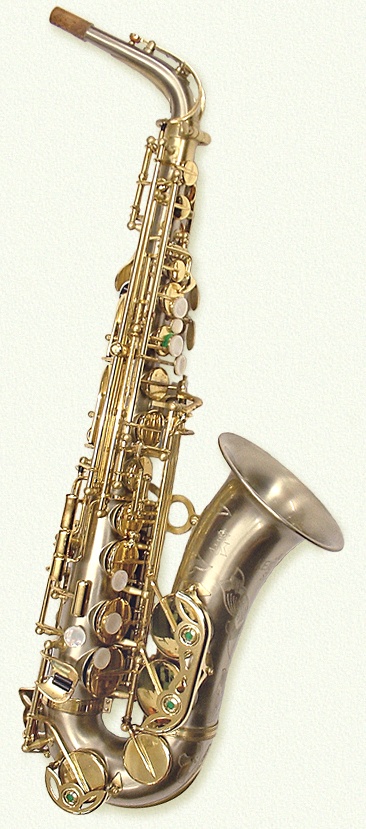 This
sax dates from around 2003, and has a solid nickel silver body.
The finish is matt, or brushed, and coated with clear lacquer, and
the horn comes in at priced of around the £2600 mark. This
sax dates from around 2003, and has a solid nickel silver body.
The finish is matt, or brushed, and coated with clear lacquer, and
the horn comes in at priced of around the £2600 mark.
On close inspection it looks a bit 'industrial', but I feel this
is more a property of nickel silver. It has the same construction
as a brass horn, it's just that the colour of nickel silver accentuates
solder and seam marks. This is probably a good reason for going
with the brushed finish rather than a high polish.
As regards general build quality the comments for
the Anniversary horn above apply. It was interesting to note that
the client who brought this horn in for a setup echoed my comments
about the thickness of the key pearls (this horn has proper mother-of-pearl
ones) and the positioning of the low C/Eb keys. I also had to adjust
the positioning of the bell key spatulas which were felt to be a
little on the low side. No big deal, and barely five minutes of
careful work to shift the touchpieces up a few millimetres.
I wasn't that impressed with the pad seating, or rather
the cup angles. Every single cup on the right hand stack leaked
at the front, which indicates that the pads are too thick for the
given cup angle. I always make allowances for horns that have been
out 'in the field' for any length of time, but this is an issue
that would have been built in (a correctly set pad that shifts or
contracts over time typically results in leaks at the rear of the
cup).
On previous examples of this model this would have been a veritable
nightmare to put right - but with flat tone holes it was a simple
matter of adjusting the cup angles and resetting the pads.
The horn blew very well, as expected. Tonewise I'd
say it was rather warm, and I noted that in the lower register,
particularly at the lower end, the horn was almost tenor-like in
its response. This is quite a remarkable achievement. I guess you
could argue that an alto should play and sound like an alto, but
there will be plenty of players out there who will love the extra
breadth of tone in the lower end.
And it comes at no cost to the upper register either, which was
clear and punchy, though with perhaps less cut and edge than a typical
alto. But then this is not a typical horn.
Even better was the fact that the tone blended nicely right across
the range, so that the fat, round lower notes eased nicely into
the brighter top notes without a sense of their being a 'step'.
It put me very much in mind of Paul Desmond, with an easy, relaxed
and tuneful tone. It might not appeal to players who like to drive
their horns, but there are plenty of other horns out there which
cater for those who prefer more of an edge to their sound.
It was certainly a joy to be able to subtone those fat lower notes
without having to up my finger pressure!
I noted a bottle of 'pad powder' in the client's case
- so the issue of sticking pads with wide tone hole rims is an ongoing
issue. Being able to dismantle the horn in front of the client and
showing him the residual crud that the powder leaves soon put him
right as to the merits of using a degreasant to address the problem.
And so, at last, I feel I can place this SX90R alongside
the competition.
I shall continue to monitor the tone hole issue as and when examples
arrive on the workbench, and I hope that never again have to draw
attention to shoddy build or poor quality control. I'm not quite
at the point where I'm ready to recommend the SX90R range wholeheartedly...I
would like to see more evidence that the problem is finally sorted
- but I'll say this much: If, and it's an important if, the problems
that plagued earlier models are now resolved, Keilwerth have an
excellent horn that's worthy of consideration against some strong
competition.
If you're in the market for a horn that hearkens back to the darker,
deeper tones of the vintage era (but without the accompanying action
and tuning issues), this is your baby!
Keep in mind the setup issues (which, to be fair, are not unknown
on other similarly priced horns), and definitely watch out for any
repetition of the tone hole problem.
Addendum
09/01/07:
 It
seems I spoke too soon. It
seems I spoke too soon.
Another nickel bodied alto arrived in the workshop
recently - this one bearing a 121xxx serial number, which dates
it as a late 2004 build.
This horn came in via my offer to inspect any SX90R
horn, and despite an initial visual inspection that looked hopeful,
the test gauge revealed a couple of flawed tone hole.
 This
horns suffered from a warp on the low C and the low Eb - of which
the low C is shown. You can quite clearly see the warp which leaves
a gap at the sides of the tone hole. The low Eb had a warp only
on one side (nearest the bell to body joint). This
horns suffered from a warp on the low C and the low Eb - of which
the low C is shown. You can quite clearly see the warp which leaves
a gap at the sides of the tone hole. The low Eb had a warp only
on one side (nearest the bell to body joint).
An initial play-test at normal volume didn't show
up a particular problem - low Bb was easily achievable, but the
same test at subtone showed a sharp drop-off in tone from D downwards.
It was possible to demonstrate to the client the effect the warps
had by fitting corks to wedge these keys shut and show the marked
improvement in tone. The same test was repeated with the client
pressing down on the Eb key cup and noting the change in tone with
each press and release.
Fortunately I was able to correct the anomalies, and
this brought about much improved stability for the lower notes.
As regards blowing in general, this is the same model as the alto
reviewed directly above - and despite a gap of just over a year
since I last played this particular model I felt that the comments
regarding the tone still apply, with the horn leaning towards a
rich but warm tone.
I am saddened that the problems I've been highlighting
for some years still exist at least as far as horns built just prior
to 2005 - and it would seem that the horn reviewed above was just
a lucky break.
I took some time to discuss with the client his reasons for buying
this horn, the results of which can be read here:
Addendum
08/02/11:
 It's
been just over four years since I last had an SX90R alto on the
bench. It's
been just over four years since I last had an SX90R alto on the
bench.
That's quite a gap for such a well-known horn, but then I probably
see twice and many professional tenors than I do altos and the SX90R
altos don't seem to be anywhere near as popular as the tenors.
So it was a welcome visitor to the workshop - brought in by a client
who wanted to take me up on my 'examine and oil' offer.
This particular model is a Shadow, and a serial number in the 125xxx
range plus anecdotal comments from the owner place its year of build
in around 2009/10.
It's quite an attractive model - the black nickel finish coupled
with the silverplated keys complement each other and lend the horn
a very elegant, almost art-deco look.
The horn has had at least a year's worth of hard playing and has
stood up well to the punishment. I had to replace a missing felt
under the A key and reset a slightly poorly seated low Bb pad -
but that's about it.
If you look closely at the top stack you might just notice that
one of the key pearls is missing (on the A touchpiece). The player
didn't seem to mind, and commented that the loss of the rather thick
pearl meant that his fingers sat better and more aligned on the
stack.
I agreed - I'm not a fan of these thick pearls, all they do for
me is make the horn feel much bigger under the fingers.
I set to inspecting the tone holes, and I'm delighted
to report that I found no warps at all. This, coupled with the inspection
of the client's Shadow tenor - which only showed up a minor fault
- indicates that perhaps more care has been taken in recent years
to address the problem. About time too (though at the time of writing
it's uncertain as to whether Keilwerth has a future).
Tonewise this alto displayed all the crispness and
depth that make the SX90R what it is.
The tone is punchy without being brash - the rich low notes give
way to the brighter upper register quite seamlessly and without
resorting to harshness to gain extra cut.
Of all the SX90R altos I've played I felt this model leaned more
to the contemporary than the others - but without losing that distinctive
nod to the warmth and depth of vintage horns. This, coupled with
a very free-blowing feel, makes this alto a very versatile instrument
indeed.
I still struggled a little with the ergonomics, but that's largely
down to the key pearls - if this was my alto I'd have those babies
off in a flash and replaced with something thinner...which would
go some way to addressing that slight sense of disconnection these
horns give me.
All-in-all a very impressive example of what Keilwerth
can do when they try - and if you can find one of these that's as
well-built as this particular model, you're in for a treat.
Addendum
20/11/11:
 This
low C tone hole is from an SX90R alto in the 114xxx serial number
range, and according to the owner it was bought new in or around
2002. This
low C tone hole is from an SX90R alto in the 114xxx serial number
range, and according to the owner it was bought new in or around
2002.
It's quite a severe warp, which left the pad trying to make a seat
on about on third of the circumference of the tone hole rim - the
peak contact points being roughly in line with the centre of the
middle key guard stay.
Also noted were slight warps to the low B and Bb tone holes.
I did some remedial work to the low C tone hole, and managed to
improve it a great deal - but it was still by no means perfect...but
at least it gave the client more than half a chance of making the
note.
Rather interestingly, the horn had recently been repadded with roo
skin pads in an effort to deal with the stickiness that had plagued
the original pads. There was still some slight evidence of stickiness,
but nowhere near as much as there was before - a point easily proven
due to one original pad having been left on (side F#). The owner
had tried a number of techniques to combat this problem, from lighter
fluid and various pad powders through to using fine carborundum
paper on the tone hole rims.
If you own a Keilwerth SX90R
series horn and are concerned or curious as to whether your horn
suffers from warped tone holes, you are invited to bring it along
to the workshop for a free inspection. In the course of the inspection
I shall examine and test the instrument and take photographs as
necessary, whereafter they will be added to the rolling reviews
(good or bad!).
There will be no charge for this, and in return for your time I
will carry out a setup and lubrication job on your sax free of charge.
|