Warped toneholes
Ever given much thought to the toneholes on your
horn? Probably not - and I don't blame you.
They're the unsung heroes of the saxophones - eclipsed by the sensual
curves of the body, the gleaming and tactile complexity of the keywork
and the seductive sound the horn makes when you play it. But along
with the action and the pads they arguably form the most important
part of the holy trinity that makes the horn work - and in this
article we're going to see exactly why this is so.
Let's kick off with a little (very) light science.
A horn is a tube, on which a mouthpiece is placed. When the mouthpiece
is blown, a note is produced. If this was all a horn was, we'd all
be playing the same note...though some of the more advanced players
would be able to produce more notes by virtue of a technique called
'overblowing', which accentuates the natural harmonics present in
the airstream and causes the note to rise in pitch.
 This
is impressive - but largely quite dull - and in order to make the
instrument more interesting a few holes are drilled into it. This
causes air to leak out of the side of the tube - which has the effect
of shortening its length. The shorter the tube, the higher the note
it will produce. Air is lazy though, and will now come out of the
first available open hole -which means you're back to playing a
single note. This
is impressive - but largely quite dull - and in order to make the
instrument more interesting a few holes are drilled into it. This
causes air to leak out of the side of the tube - which has the effect
of shortening its length. The shorter the tube, the higher the note
it will produce. Air is lazy though, and will now come out of the
first available open hole -which means you're back to playing a
single note.
But if you're able to block off these holes at will, you can pick
and choose which note the tube will produce.
On an instrument as simple as, say, a recorder or a penny whistle,
the holes are simply drilled into the tube and the player blocks
them off with their fingers. On larger instruments this is impractical
- if not impossible - and so a system of keys is fitted. This allows
the player to close off quite large holes some distance away from
the reach of their fingers.
As you can see in this diagram, the air coming
in from the mouthpiece has to pass by a number of closed holes before
it reaches an open one - whereupon it's able to escape and thus
produce the desired note (a B, in this case).
And that's the basic science. From here on it's
all about refining it to make it reliable and efficient - and this
begins with making the keywork slick and comfortable, fitting pads
to ensure a tight seal against the holes...and raising the holes
out of the body tube so that the pads have a flat and true surface
to seal against.
How well this system works depends on three things; the mechanical
accuracy of the keys, the integrity of the seal provided by the
pad and the flatness of the tonehole. Hence the holy trinity.
If any one of this trio isn't up to par it'll
have an effect on the precision of the seal, which in turn has an
effect on how well the horn plays (and sounds). An imprecise action
can be dealt with - things can be tightened up and adjusted. A bad
pad can be replaced or reset - but an inaccurate tonehole can present
some difficulties inasmuch as it's not always easy to tell how level
they are, and their design may hamper any efforts to improve them.
 And
here's why this matters. And
here's why this matters.
This diagram shows a key cup sitting atop a tonehole, with a pad
inbetween. Everything is nice and level, and it's a fair bet that
the pad is making a good seal against the tonehole.
This is as good as it gets, and you can be pretty sure that as the
pad ages and shrinks, it'll do so evenly - which maximises the likelihood
that it will maintain the integrity of the seal down the years.
Contrast this with a pad that's sitting against
a tonehole with a dip in it. You can quite clearly see that there's
a gap between the rim of the tonehole and the face of the pad because
the rim of the tonehole isn't level. It's warped.
 You'd
be very lucky (or unlucky, I suppose) to see a warp as clearly as
this as they're often far less severe and are usually hidden or
disguised by the seat impression in the pad. But the leak will still
be there. You'd
be very lucky (or unlucky, I suppose) to see a warp as clearly as
this as they're often far less severe and are usually hidden or
disguised by the seat impression in the pad. But the leak will still
be there.
How severe the leak is will depend on many things, such as the severity
of the warp and the age and condition of the pad. And how it was
set.
It's a common misconception that pads are designed
to take up any discrepancies between the toneholes and the key cups.
In fact they can take up very little without sacrificing reliability
- and the gold standard when setting pads is to ensure they make
a good seal with the absolute minimum amount of pressure applied
to them. However, new pads are quite supple and can be forced (typically
by clamping them down hard against the toneholes) to accommodate
quite large tonehole warps - but once the force is removed they
start to relax and expand. This can take many months, or it can
happen overnight - but one thing's for sure, it will
happen...and it will leak.
This property is a boon for manufacturers who use 'compression setting'
for pads - because by the time you begin to notice there's a problem
you'll have already begun compensating for it (higher finger pressure,
changes in embouchure)...and it could be quite some time before
you realise that your horn's not really working that well.
What level toneholes give you is more response
- and a faster one at that. By reducing the amount of work the pad
has to do, you're increasing the 'percussiveness' of the note. Reliability
goes up too , and the feel of the action becomes more solid - which,
in a funny kind of way, also makes it more transparent. In other
words it's functioning to the best of its ability, which means you
can forget about it and concentrate on your playing.
There's also another benefit to having perfectly flat toneholes
(at least for repairers) - and it's that it provides a measurable
point of reference. Take two horns; one with level toneholes, one
without - and drop them. Damage will ensue. A repairer will want
to determine exactly what's been damaged. Some of it might be obvious
- like a dirty great dent in the body - but some might be very subtle.
Let's say that both horns now have a leak on the low C key despite
there being no sign of a dent or a bent key. The first question
that's going to arise is "Has the tonehole been damaged?"
You're going to be out of luck with the horn that didn't have level
toneholes because there's no way to tell whether it's the tonehole
that's moved, or the the key cup. Could be either - might be both.
But on the horn with levelled toneholes all you need do is pop a
flat standard on it and see if it's out of true. If it is - there's
the problem. If it isn't, it's going to be the key.
Without a measurable point of reference you have to resort to your
best guess.
 Now
that we've established what a pad is and isn't supposed to do, let's
have a closer look at the toneholes themselves. Now
that we've established what a pad is and isn't supposed to do, let's
have a closer look at the toneholes themselves.
There are two types of tonehole in common use; the straight or plain
and the rolled.
As you can see from the diagram, the straight or plain tonehole
is piece of tube that extends from the body of the horn. In years
gone by, the toneholes would have been made separately from the
body and fitted to it - and this type of tonehole is known as a
soldered-on tonehole. It's an expensive procedure and tends not
to be used much these days (though many flutemakers still use it)
- and it's not without its problems.
Most modern toneholes are pulled or 'drawn' out of the body material
itself - and are described as plain drawn toneholes. It's quite
a brutal process that places a very great deal of stress on the
body, and a lot can go wrong if it's not done right.
The other type of tonehole is the rolled type.
As far as I'm aware these are always drawn out of the body (I've
never yet seen a soldered-on rolled tonehole), and it differs from
the plain type in that the rim of the tonehole is turned out on
itself. In other words it's rolled over - hence the term.
It's an even more brutal process than drawing a plain tonehole out
of the body - and there's even more that can go wrong if great care
isn't taken during the drawing and rolling process.
There are a couple of variations to the above.
Some horns feature quite substantial (AKA thick) toneholes, and
these are always of the soldered-on variety. The best place to spot
these is on a vintage Martin. Another variation is the soldered-on
roll, as commonly seen on some Keilwerth saxes. This is a plain
drawn toneholes to which a 'roll' has been fitted over the rim.
It's not a true roll, however - it's a solid bead designed to look
like one. As you might imagine, there are pros and cons associated
with the various types of toneholes - both in terms of how they
affect the playability of the horn and the sort of problems that
arise when things go wrong - and it should be clear by now that
the most important mechanical property of a tonehole is that it's
level. But why might they not be level, how can you tell and what
can be done about it?
Spotting a warped tonehole isn't always easy.
Obvious warps ought to be easy enough to spot, particularly if you've
just dropped your horn and put a couple of choice dents into it
- but most warps are rather more subtle. As unhelpful as it is,
I'm afraid that an awful lot of diagnosis is down to having a practised
eye and a well-developed sense of things 'not looking right'. Which
is a fat lot of use to you, I know.
Fortunately it's not too difficult to acquire this skill provided
you own a number of tubular objects - such as coffee cups, tea mugs
and wine glasses.
If you gather together together half a dozen of these and place
them end down on a work surface and then gently rock them back and
forth, you might be quite surprised to find that most of them will
be uneven.
Hold one of them up so its rim is at eye level, then 'sight' across
it. Twist it towards you, then away - and note how it looks when
the rear of the rim disappears behind the front. Turn it around
and do it again, to get a different view of the rim. If you can
find a cup/mug/glass that's obviously uneven, so much the better
- it makes it far easier get the 'feel' of how a warped rim looks
when you sight across it.
 But
even when you've acquired and polished this skill, it's still a
very crude diagnostic tool - and it's often the case that the only
way to know whether a tonehole is warped or not is to test it against
a known flat standard (an object of known flatness). But
even when you've acquired and polished this skill, it's still a
very crude diagnostic tool - and it's often the case that the only
way to know whether a tonehole is warped or not is to test it against
a known flat standard (an object of known flatness).
For example, this is a (rolled) tonehole on a
Conn 10M tenor sax - and at first glance it seems just fine. If
you hold the horn up at eye level and sight across the rim, it appears
to be level.
There are no obvious warps, it all looks pretty even - and even
an experienced eye would probably pass it off as fine.
 But
if you put a flat standard over it and shine a light up through
the tonehole, it quickly becomes apparent that all is not well. But
if you put a flat standard over it and shine a light up through
the tonehole, it quickly becomes apparent that all is not well.
There are at least two high points - which result in a gap of around
5 thousandths of an inch (5 thou) on either side of the high point.
If the rear of the tonehole is the part that faces the key's pivot
screw, then the high spot - seen by the dark area sandwiched between
two obvious gaps - is at around the 4 o'clock position, with a corresponding
high spot at the 10 o'clock point. There's also a lesser high point
at the 8 o'clock position.
While such a warp isn't impossible to see with
the naked eye, it's still rather a tough call - as the eye is easily
fooled by reflected light and curved surfaces. This is why a flat
standard is required - it leaves no room for doubt. But is such
an apparently small warp something to be worried about?
Yes it is. When setting a pad you're generally working to a tolerance
of less than 1 thou (the thickness of a silver Rizla paper, often
used as a 'feeler' for testing the accuracy of a pad seat) - so
any gap larger than that will represent a potential (and highly
probable) leak.
As for what causes warped toneholes, it's most
commonly down to poor manufacturing. As mentioned above, the process
of drawing a tonehole out of the body requires a great deal of force,
which means the metal is going to be stretched. As hard as most
metals are, they're surprisingly elastic under certain conditions
- and a metal as soft as brass is about as bouncy as it gets.
What tends to happen is that the tonehole is pulled out of the body
- and having been pulled it's likely to be rather uneven across
the rim. This isn't a problem as there's usually quite a lot of
unwanted height to the tonehole at this stage - and so it's machine
cut (milled) down to size and flatness.
At each manufacturing stage you're adding stress to the metal -
from the pull of the drawing procedure to the push of the milling
process. This leaves the metal in tension - and unless it's deliberately
relieved (usually by heat treating the metal), it'll find its own
way out at a later date as the metal 'self relieves' itself.
It's a little bit like the seasoning process that wood goes through,
so that your floorboards remain flat and true when fitted...and
don't start curling up on you after you've laid a carpet over them.
Unfortunately not many manufacturers take the greatest care over
relieving the tension - which is why I'm often pointing out warped
toneholes on brand new (and often quite expensive) horns.
 It's
also the case that tension can be added by the assembly process.
Parts will be soldered onto the horn, the body will be slid over
various mandrels and holders and then the various body sections
will be joined together. It's all 'working' the metal, and it all
has an effect. It's
also the case that tension can be added by the assembly process.
Parts will be soldered onto the horn, the body will be slid over
various mandrels and holders and then the various body sections
will be joined together. It's all 'working' the metal, and it all
has an effect.
Self relieving shows up in a variety of ways, but by far the most
common is through an 'apex hump'.
In this somewhat exaggerated graphic you can see that the rim of
the tonehole rises to a hump across its most shallow point, which
corresponds to the apex of the body tube beneath the tonehole. The
typical result of an apex hump is a leak at either the rear or the
front of the pad...and in some cases both.
Another cause of wonky toneholes is down to a
plain old knock or drop.
Such damage is often unpredictable in its effects and can range
from gentle apex humps right through to almost complete obliteration
of the tonehole.
For the most part the cause of the damage is pretty obvious - a
sickening thud, a couple of dull clunks and a great deal of swearing
- but sometimes it's rather more subtle. For example, a light knock
to the bell might not appear to cause any damage, but the shock
wave that precipitates from it can lead to a very slight (typically
forward) bend in the body...and this will usually lead to a cluster
of toneholes exhibiting slight apex humps.
The same effect can be achieved by regularly swinging your horn
around on stage (showboating) or carrying it around in a crappy
case that lacks proper internal support.
So much for the causes then - let's now have a
look at what can be done about a warped tonehole.
As a general rule the starting point for addressing the problem
is to ascertain what caused it, because this will have a bearing
on which techniques will be used. If a bend or dent in the body
is the cause, it follows that removing the bend or dent will restore
the level of the tonehole. And so it will, more or less. However,
it gets a bit more complicated when the problems are down to manufacturing
issues.
 Here's
a plain tonehole that's seen a bit of damage, which has resulted
in a visible dip to one side of the tonehole. You can see that the
dip is due to a dent in the body adjacent to the tonehole - and
it's reasonable to assume that if the dent is pushed out, it'll
bring the tonehole back to level. With some patience and care, and
a family-sized bucket of skill, a repairer should be able to restore
the tonehole to within (say) 95% of level. That's not bad - and
in the real world that's workable enough to take up the remaining
inaccuracies with some careful tweaking of the pad. Here's
a plain tonehole that's seen a bit of damage, which has resulted
in a visible dip to one side of the tonehole. You can see that the
dip is due to a dent in the body adjacent to the tonehole - and
it's reasonable to assume that if the dent is pushed out, it'll
bring the tonehole back to level. With some patience and care, and
a family-sized bucket of skill, a repairer should be able to restore
the tonehole to within (say) 95% of level. That's not bad - and
in the real world that's workable enough to take up the remaining
inaccuracies with some careful tweaking of the pad.
But to achieve 100% it's very likely that the rim of the tonehole
is going to need some attention.
Like any previously flat surface that's been 'distressed',
some topical levelling is required - and this is typically done
with the aid of a tonehole file.
These are available as wide, flat files or as discs - and both types
can be found with abrasive media on the face (such as diamond grit)
rather than a file face. The principle is simple; a file is selected
that fully covers the rim of the tonehole, and then the file is
worked (or in the case of a disc, rotated) over the rim until it's
level.
They are, however, somewhat unselective in operation. In theory,
the file should rest upon the highest spots on the rim - and as
the file is pushed or rotated over the surface, these high spot
are brought down to the same level as that of the lowest spots.
And this would be true if it were possible to ensure that the file
remained in its original orientation with each pass or turn.
This is very rarely the case, and as the file tilts it often cuts
into the low spots well before the high spots have been dealt with.
This has the effect of lowering the overall 'table', so that by
the time the file is cutting evenly all the way around the rim,
it's cut deeper than was really necessary. This is why my round
tonehole files tend to see more action when inverted and used as
flat standards rather than as files. It is, however, quick and reasonably
accurate (provided you have a steady handy).
Unfortunately it's often the case that a repairer will spend too
little time on the dent/bend work before reaching for the file.
It's usually quite easy to bring such a tonehole up to (say) 90%
of level...but getting that last 5 or 10 percent takes progressively
more time and care.
A more selective method is to use a flat standard
so that the high spots on the rim can be accurately observed and
can be tackled individually with a small, fine file or a sharp scraper.
In this way the tonehole is brought back to level slowly and carefully
with the least amount of material lost.
It takes a lot more time, and requires some judgement as to the
order in which each high spot is tackled because the table will
change with every stroke of the file. With that said, experience
soon teaches you to recognise certain warp patterns and how best
to deal with them - and it can be quite surprising how little material
needs to be removed. It's also a great deal more accurate than just
using a tonehole file
This is all good and well for a previously level
tonehole that's taken a knock - but what about one that was never
level in the first place?
Such a situation comes about because of poor manufacture and indifferent
quality control - and it's disappointingly common.
In this case there's no underlying distortion of the body tube to
be corrected, and the decision has to made as to whether to tackle
the tonehole as-is, or deliberately distort the body tube to correct
most of the anomaly first. This can be a tough call - after all,
no-one wants to take their horn to repairer to have them knock a
bulge (we call it a 'reverse dent' in the trade) in
to their pride and joy - but sometimes it's the only way to avoid
taking very large amounts of material off a tonehole.
A slightly more refined version of this technique
is 'tapping down'. At its most basic level it involves tapping the
raised portion of the tonehole to bring it level with the lowest
portion, though it's a bit more involved than simply taking a hammer
to the rim of the tonehole.
Typically a plate-like tool is placed over the high spot, and it's
this that's struck. It spreads the impact and lessens the chance
of damaging the surface of the rim. Levers are also used, to raise
low spots without overly affecting the adjacent body tube.
If all else fails there's always the fallback
of pad manipulation. I tend to follow the principle that the best
and most reliable pad seat is achieved with a level key cup holding
a level pad that meets a level tonehole. You nearly always have
to tweak and fiddle with a pad seat - but there's a world of difference
between making small, precise adjustments to close up pinprick leaks
and forcing the face of the pad into a curve to accommodate a wonky
tonehole. But sometimes it's the lesser of two evils and, provided
it's done carefully, gives acceptable results - though with some
reduction in long term reliability of the seat due to the tendency
of pads to shrink over time.
There are a couple of ways in which pads are manipulated; some repairers
like to 'float' the pad in the key cup on a thick bed of shellac
- pulling out or pushing in part of the pad to allow the hot, molten
shellac to make up the necessary adjustment in the key cup and then
holding it place while it cools. Others prefer to fit shims (typically
made from card) behind the pad to make the bulk of the adjustment,
followed by minor push/pull tweaks to suit. Long and tedious arguments
rage over which method is best - but most repairers are happy to
switch between methods to suit the circumstances.
Note that pad manipulation is quite different from compressing a
pad in order to force it to seat. Manipulation aims to keep the
pad in as relaxed a state as possible even though it's not flat
- whereas a compression-set pad will nearly always expand and lose
its seat after a period of time.
There is another method - called 'mallet seating'...which
means you simply bash the crap out of the key cup to deform it to
match the warped tonehole. It's strictly a bodge, but if you're
mucking about with a cheap, beat-up old banger, it's surprisingly
(and annoyingly) effective. I should point out that this technique
is distinctly different from that of carefully and precisely tapping
the key cup to adjust its angle.
There's a lot of debate about the ethics of levelling
toneholes, and a great deal of it seems to come from a misunderstanding
(on both sides) of the processes involved.
Heading up the 'against' stance is the view that any material removed
from the tonehole cannot be replaced. This is true - mostly. It
is possible to replace lost material, but it's tricky and expensive...so
there's some merit in this standpoint.
Heading up the 'for' stance are those who insist that the tonehole
must be completely level. This is the ideal, to be sure, but it
must be carefully weighed against the need to maintain a horn's
structural integrity.
Inbetween the two is the middle ground, where skilled judgement
calls are made with regard to the state of the toneholes and the
techniques most suited to the problem in hand...and this may vary
from tonehole to tonehole. If you find yourself being told that
your horn has a wonky tonehole, you're perfectly entitled to ask
how the issue is going to be addressed - and to ask for a thorough
explanation of the proposed treatment, as well as the alternatives.
No decent repairer will refuse to disclose such information - and
in all probability will bang on about it at length...for at least
as long as it takes you to begin to regret that you ever asked in
the first place.
 When
it comes to dealing with rolled toneholes there's an extra complication
to be taken into account - which is that the design generally precludes
the option of filing the toneholes...and here's why. When
it comes to dealing with rolled toneholes there's an extra complication
to be taken into account - which is that the design generally precludes
the option of filing the toneholes...and here's why.
If you file a plain drawn tonehole you're taking
material off the end of a tube. In theory you could keep filing
it until the tube was flush with the body - at which point you'd
have turned your rather nice horn into so much scrap metal. In practice,
however, you'd reach the 'scrap point' a great deal sooner - because
the horn relies on the toneholes being a certain height for mechanical
and acoustic purposes.
Here's a diagram of an all-too-common example of a tonehole that's
been over-filed. As you can see, it sits so close to the adjacent
pillar that the pad overhangs its base - and so much 'meat' has
been taken off the tonehole that its rim now sits just below the
height of the pillar's base. This means the pad will hit the pillar
base before it hits the tonehole. This is, understandably, going
to cause a lot of problems.
You might be able to bend the key slightly so that the pad sits
off-centre, and thus misses the pillar - but it's a poor fix that
comes with its own set of problems...and it's pretty much useless
if, as is sometimes the case, the pillar base butts up against the
tonehole wall.
About the only workable solution is to file some material off the
pillar's base to reduce its height to below the level of the tonehole
rim. It would certainly allow the pad to seat, but because the tonehole
is now so shallow there's a good chance that the tuning might be
slightly unpredictable.
Whichever way you look at it, it's not good - but the cogent point
is that there's nothing to prevent you from filing a plain drawn
tonehole right down to the body.
 When
a tonehole is rolled it means you'll be working on the side of the
tube rather than the end - which means there's a very finite amount
of metal to work with (the wall thickness of the tube, to be precise).
This is further complicated by virtue of not knowing whether the
tonehole has been filed in the past, or by how much the rolling
process has thinned the tube wall. When
a tonehole is rolled it means you'll be working on the side of the
tube rather than the end - which means there's a very finite amount
of metal to work with (the wall thickness of the tube, to be precise).
This is further complicated by virtue of not knowing whether the
tonehole has been filed in the past, or by how much the rolling
process has thinned the tube wall.
This is an extremely important consideration given that the wall
thickness of the tonehole is likely to be around just one millimetre
or so. There's really very little metal to play with, and the more
you file it, the greater the risk that you'll break through the
roll into the hollow beneath it. This would be extremely bad news.
An additional complication is that filing down
the apex of the roll will increase the width of it - and although
it's not fantastically important it nonetheless has a bearing on
the efficacy of the pad seat. As the diagram shows, the unfiled
roll on the left presents a working surface to the pad that's just
a bit wider that the wall thickness of the tonehole tube. Compare
that to the roll on the right, which has been filed. The working
surface is now more than double the wall thickness. Such an increase
in surface area decreases the closing force against the pad, and
increases the likelihood that the pad will stick - and the worst
of it is that the surface area will likely vary all the way around
the tonehole rim, where some areas have been filed more than others.
As you can hopefully see, it takes a fair degree
of experience and skill to determine whether such a tonehole can
tolerate some filing - and just how much it can take - which is
why the standard advice is that rolled toneholes should never be
filed. In other words - if you're not absolutely certain that you
really know what you're doing (and why), leave well alone. If, however,
you're sure that the tonehole can tolerate it, and it's the best
method for addressing the problem, a very light dressing
can bring substantial improvements to the integrity and reliability
of the pad seat.
 Remember
that Conn tonehole from earlier? Remember
that Conn tonehole from earlier?
Here it is again after a spot of careful tapping down and a very,
very light bit of selective filing.
It's very much improved, to the point where the remaining gaps (now
reduced to less than 1 thou) could be easily dealt with by some
gentle pad manipulation. This is a good as it 'needs to be' - though
another round of tapping down and gentle filing would bring the
rim even closer to 'spec'.
And once a pad is properly set against this tonehole you could have
every confidence that it would remain so for very many years.
I'm often accused of having a 'thing' against
rolled toneholes - probably because horns that feature them tend
to get a lot of stick in my reviews. Most of this is down to the
fact that the design is complete pain in the arse when it comes
to dealing with warps - and also because they're very hard to manufacture
properly - but it's worth taking a moment to look at the pros and
cons in detail.
On the plus side the extra metal at the top of the tonehole adds
more mass and stiffness to the rim. The mass is probably of little
use, but the extra stiffness could be useful...even if it's only
a little.
The roll presents a larger surface area to the pad. This will certainly
reduce pad wear because the surface of the roll is likely to be
quite smooth - it will reduce abrasion. The larger surface area
will also mean a softer feel under the fingers and reduce pad contact
noise (that sort of slapping sound you get when you press a key
down).
On the down side the larger surface area effectively
halves the force of the pad against the tonehole rim. A pad pressed
with a 'playing force' of 4oz against a 40mm plain tonehole will
seal with a force of around 1.3 pounds per square inch. Against
a rolled tonehole of the same diameter, the sealing force drops
to 0.67 pounds per square inch. This is more likely to be an issue
on pads that are normally held closed (such as the G#, side Bb/C
keys and the low Eb) - the larger pad contact area increases the
likelihood of the key cup being forced open during playing. You'd
negate this by increasing the key's spring tension, and thus the
closing force of the pad...but this will make the action heavier.
The larger surface area means more gunk and goo
can collect between the tonehole rim and the pad. This typically
results in a sticky pad, which can be especially problematical on
those pads that are normally held closed. Again, this can be negated
to some extent by upping the spring tension, and by keeping the
pads/tonehole rims clean.
The additional stiffness provided by the roll
may well help in the event of very light knocks - but if the horn
takes a hefty whack, it's going to bend...which means someone's
going to have to jump through hoops in order to level off the affected
toneholes. It's this disadvantage that almost comprehensively
outweighs any of the other pros and cons - and I say almost because
it all hinges on just how well the toneholes are made in the first
place.
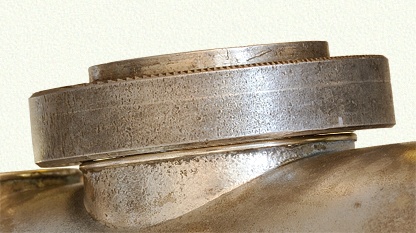
It's fair to say than Conn were the masters of rolled toneholes,
but even they had quite a few hits and misses. The problem these
days is that there's an erroneous association with rolled toneholes
and the lush tones of yesteryear's vintage horns. Why erroneous?
Because it's much more likely that this tone is down to the overall
quality of manufacture rather than a single design feature. Not
that this stops certain modern manufacturers from having a go...with
woefully mixed results.
 For
example, in my review of the Mauriat
67RUL alto I noted a number of problems with the rolled toneholes.
Many were uneven, some had been filed (one severely so) and some
were malformed inasmuch as the roll had not been fully formed. For
example, in my review of the Mauriat
67RUL alto I noted a number of problems with the rolled toneholes.
Many were uneven, some had been filed (one severely so) and some
were malformed inasmuch as the roll had not been fully formed.
In fact the roll looked rather like this - half-formed, incomplete...and
rather flaccid really.
I would be less concerned if this was a one-off example, but I've
seen similar problems on other models from the same manufacturer
- and thus it's entirely fair to assume that there's an ongoing
production/quality control issue.
What really bugs me is that there's been nigh
on a hundred years of industrial development since the first rolled
tonehole appeared on a horn - and in this age of computerised manufacture
and automated quality control it's a process that really ought to
have been nailed down once and for all.
But it isn't, and what with all the other disadvantages associated
with the design, I really don't see any practical reason to recommend
them.
And this brings me neatly onto the pseudo-rolled
tonehole.
This type of tonehole was pioneered by Keilwerth, and can be thought
of as being a hybrid between a plain and a rolled tonehole.
In purely engineering terms it's a very neat idea, because the process
of a rolling a tonehole is difficult and expensive. If you make
a mistake, you've trashed the horn (assuming you care) - so finding
a process that gave you all of the supposed advantages of a roll
with none of the manufacturing costs and difficulties was a boon.
 And
it's a surprisingly simple design - you just fit a ring onto the
top of a plain drawn tonehole. How brilliant is that? And
it's a surprisingly simple design - you just fit a ring onto the
top of a plain drawn tonehole. How brilliant is that?
Naturally, it'd be a proper pain in the rear trying to fit a ring
atop a tonehole rim (what with it falling off all the time), so
the tonehole wall and the ring are designed to slot together - and
this feature holds the ring in place while it's soldered on.
What could possibly go wrong?
Well, as it happens, quite a lot.
A number of Keilwerth horns turned up in the workshop with wonky
toneholes. This was rather puzzling, given that I assumed the toneholes
were drawn, levelled and then morticed to accept the ring...which
should have meant that there was no scope for the assembled hole
to be anything but level.
Regrettably this turned out not to be the case at times - and the
most likely reason was the dreaded 'self relieving' phenomenon mentioned
earlier. And in some cases the fit between the ring and the tonehole
was less than optimal, which resulted in some rings being fitted
a little (shall we say) unevenly.
 Here's
a fairly typical example, and it's quite plain to see that the warp
is a very great deal worse than the one on the Conn shown earlier.
There are decades between the build dates of these two horns, and
the Conn features a proper roll - which is a far more demanding
manufacturing technique. Not to put too fine a point on it, it's
unforgivable on any horn...let alone on a premium brand. Here's
a fairly typical example, and it's quite plain to see that the warp
is a very great deal worse than the one on the Conn shown earlier.
There are decades between the build dates of these two horns, and
the Conn features a proper roll - which is a far more demanding
manufacturing technique. Not to put too fine a point on it, it's
unforgivable on any horn...let alone on a premium brand.
What makes this a particularly pernicious problem
is that the defects are manufactured in - so you're immediately
limited in terms of the techniques you can use to remedy the problem.
There are no dents to knock out, no bends to straighten. The bottom
line is that you're either going to have to resort to filing the
tonehole, or settling for distorting the bore to bring them up to
level - and neither option is an attractive proposition for the
reasons discussed earlier. With that said, there's at least no chance
of breaking through the roll (because it's solid). You could, of
course, opt for manipulating the pads - but this isn't very reliable
in the long term and it's really not the sort of thing that should
be required on such an expensive instrument. As a final resort you
could always unsolder the rings and refit them - but the consequent
damage to the horn's finish would not be a matter of much joy.
On a brighter note it would appear that in recent years steps have
been taken to improve the construction and quality control of the
horns that have this feature - but I'm still keeping my eye on them.
And that just about wraps it up for toneholes.
Hopefully you'll have learned a few things, and are perhaps more
aware of just how much of an impact they have on how well your horn
functions.
|