




Oiling the boreOiling the bore of a clarinet (or any other wooden-bodied woodwind instrument) is a tricky business, though once the technique is mastered it's quite simple.This page is divided into three sections, you can skip the first section if you're confident you really want to oil the bore. It's a relatively large document, so I'd advise you save it as an html document and read it at your leisure. Section One covers
the theory, and discusses the pros and cons of oiling the bore
Wood is a living material. Long after the tree has been felled, the wood continues to move and breathe. If left to its own devices, wood will eventually break down (with the aid of moulds and fungi) in a process we know as ‘rotting’. Some woods are more resilient than others, and thus we choose these woods to make objects that will survive for long periods of time in extreme environments. The Blackwoods (a large family of dense, hard woods) are most commonly used for woodwind instruments - with a close grain structure and good stability they lend themselves well to the manufacturing processes needed to make a complex turned and bored structure such as the body of a clarinet. But even these very dense woods need care and attention
if they are to survive in an environment that is usually wet and humid. When wood loses its natural oils several things happen. The wood dries out - and if it remained dry then perhaps there would not be too many problems, but once the oils have gone it leaves the structure dry and sponge-like - and thirsty. What happens next is that the wood begins to absorb moisture from the atmosphere. This moisture provides the perfect breeding ground for the moulds and fungi whose job it is to break down the wood so that our planet is not littered with dead bits of wood. The lack of oil has another effect. Water tends to be more volatile
than oil - that’s to say that if you placed a drop of water beside a drop
of oil on a plate of glass it’s the water that evaporates first. And this
happens within the body of a wooden instrument too. There are drawbacks though. These then are the basic pros and cons. It is here that I must state my personal and professional reasons for
advocating the oiling of the bore. When a joint locks it exerts considerable pressure on the socket - which is why splits and cracks are a common sight on old instruments like these. It’s really quite something to see when a drop of water is placed on the bore of one of these ancient instruments - it soaks into the wood in no time at all, and any attempt to play such an instrument could do untold damage as the wood would absorb all the moisture it could get. But with careful and patient oiling the wood can be revived and stabilised. There's another good reason for oiling the bore. Many old clarinets that
haven't seen a lick of bore oil for years often have a dull white coating
on the bore. This is essentially scale - much the same as you might find
in your kettle. It serves no purpose in a kettle, so you can imagine how
useless it is in the bore of an instrument. It blocks the pores of the
wood, fouls up the tone holes and affects the tone - and the tuning in
extreme cases. The worst example I have seen of the wood drying out was a Serpent that
was given to me for ‘restoration’. Wood has a ‘feel’ to it. Over the years, if you handle wood on a day-to-day
basis, you get to understand it - and there’s many a time when I pick
up an old clarinet and note that it doesn't ‘feel’ right. It feels too
light. Too dead. Too cold. Oil brings the wood back to life, restores
a sense of ‘body’ to the instrument - and best of all it makes it playable
again without risk of damaging the wood. It is not economically viable (as far as I know) to extract natural oils from wood on a large scale - it would destroy the wood, which defeats the object of cutting the tree down in the first place - so a substitute must be found, and ideally the oil must closely match the properties of the natural oil. Vegetable oils are the closest match, but not all such oils are suitable.
Some have certain properties that render them useless for our purposes. There are two oils in common use for our purposes: Groundnut (or peanut)
oil and Sweet Almond oil. (* Not that many people would consider drinking bore oil - but guitarists often use bore oil for treating fingerboards...and some guitarists will drink anything that comes in a bottle, even industrial-grade mineral oil). There has been some debate as to the risk of such oils going rancid. In theory all vegetable based oils will break down over time - but this assumes a quantity of oil left standing for a considerable amount of time. I have never found this to be a problem once the oil is applied to the bore - but you'd be well advised to ensure you use fresh oil in the first place. Choosing an oil like groundnut makes good sense in that it's a culinary oil...you can use it in the kitchen, thus ensuring a regular turnover of fresh oil. Specialist oils are also available. These are very much a cut above the
generic oils often sold in music shops, and most are only available via
mail order online. Companies such as The Doctor's Products
sell a range of high-quality bore oils, including one made from Grenadilla
wood oil - it's suitably pricey. Naylors
is another company that sells a good quality bore oil. These oils are absolutely fine for the job - if there's a drawback to them it's only that you have to order them specially and that they work out a bit more expensive than culinary oils. They're a good choice if you want to do a proper job but you're a bit uncertain about buying oils from a grocery store. There are several methods of oiling the bore - but the one I am going to describe is, I feel, the safest for players who are oiling an instrument that has not been stripped down. What you will need: Your oil: You can decant it into a small bottle and mix in a little methylated spirits (wood alcohol) in the approximate ratio of seven parts oil, one part meths. Shake very well. This helps to thin the oil slightly, and disinfects the bore. Clean up stuff: A few sheets of tissue or kitchen roll - to wipe off excess oil - and perhaps some lighter fluid and pipe cleaners, in case any of the pads get contaminated with oil. An applicator: There are many alternatives. Given that I most often
work with stripped down instruments I tend to favour an old clarinet 'Pad-Saver'. In this instance I'll show you how to make use of a oiling rod. You'll need to wrap this strip around your rod. Simple enough, but you
have to ensure two things - 1: that the tip of the rod is covered (not
so critical with a wooden rod) and 2: that the cloth will not unwind.
If it does so it may get wedged into the bore.
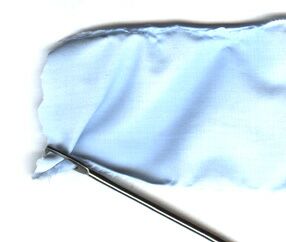
Now roll the rod over into the cloth....
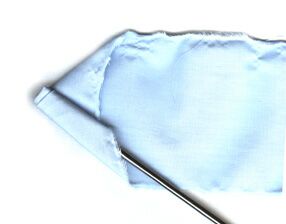
To protect the tip of the rod fold the top of the cloth down over it...
Now continue to roll the rod, feeding the cloth tightly down the rod as you go...
And you should end up with this...
The reason I specified strip of cloth about a foot long is that you'll now be able to keep hold of the end of it as you use the stick to oil the bore. This'll prevent the cloth coming loose. This is what you do: The applicator is inserted into the bore of the barrel - slowly and with a twisting motion. Take care to twist it in the same direction as the cloth was wound on...otherwise it may unwrap and lodge in the bore. Work it back and forth - gently. Examine the bore of the barrel - you are aiming to just dampen the bore evenly. Any obvious drips and runs mean you have far too much oil on the applicator. Run it through a kitchen towel to remove the excess oil - or work it out on the exterior of the barrel, or have a go at the bell. It is very important that you gauge the amount of oil on the applicator carefully - the aim is to smear the oil on, not slosh it. Then do the bell. Again, as this has no keys you can’t do any harm if you have too much oil on the applicator. Once you're sure you have the right balance of oil you can proceed to the main joints. Wash or wipe your hands first to avoid getting oil on the keywork. Now the hard part. Start with the lower joint. Very carefully
insert the applicator into the bottom joint from the lower end (AKA the
bell end - no laughing at the back...). Don't apply too much downward
pressure - the applicator ought to be a loose fit in the bore, and if
you press it down onto the bore you run the risk of forcing excess oil
out. Keep a very careful eye on the lowest tone hole. As the applicator
passes the tone hole the edges of the hole might force oil out of the
applicator. If oil runs into the tone hole then you could be in trouble.
Keep the instrument level, with the keys uppermost, so that if any oil
does dribble it won’t head straight for the pads. Tricky, isn't it?! The golden rule is to use as little oil as possible. Better to have to push the applicator in half a dozen times than risk it oozing oil everywhere. You'll be surprised at how 'dry' the applicator appears at first - and yet it also surprising just how much oil it can hold, which you usually find out too late. Once you’re happy with the oil job - leave the clarinet to stand for an hour or so. After an hour or so, inspect the clarinet. You should find
that the oil has been absorbed into the two main joints. Excess oil in
the bore can be cleaned out by threading a clean piece of cloth on the
rod and repeating the above directions, but without any oil. Clean up
the bell and the barrel, and check the tenon sockets for any excess oil. And that’s about it really. Bear in mind that it’s unlikely your instrument will fall
apart if you miss out an oiling or two - it’s really a preventative and
preservative technique. If your instrument is very old and hasn't been
oiled for many years then you may need to oil it very lightly
once a week for a month or so. Don't try to do it all at once - the stresses
it can impose on the wood may lead to it splitting. New instruments will
not need oiling in the first year - in fact you'll probably find that
your pads get discoloured as the wood's natural oils leach out.
|



If you've enjoyed this article or found it useful and would
like to contribute
towards the cost of creating this independent content, please use the button
below.